
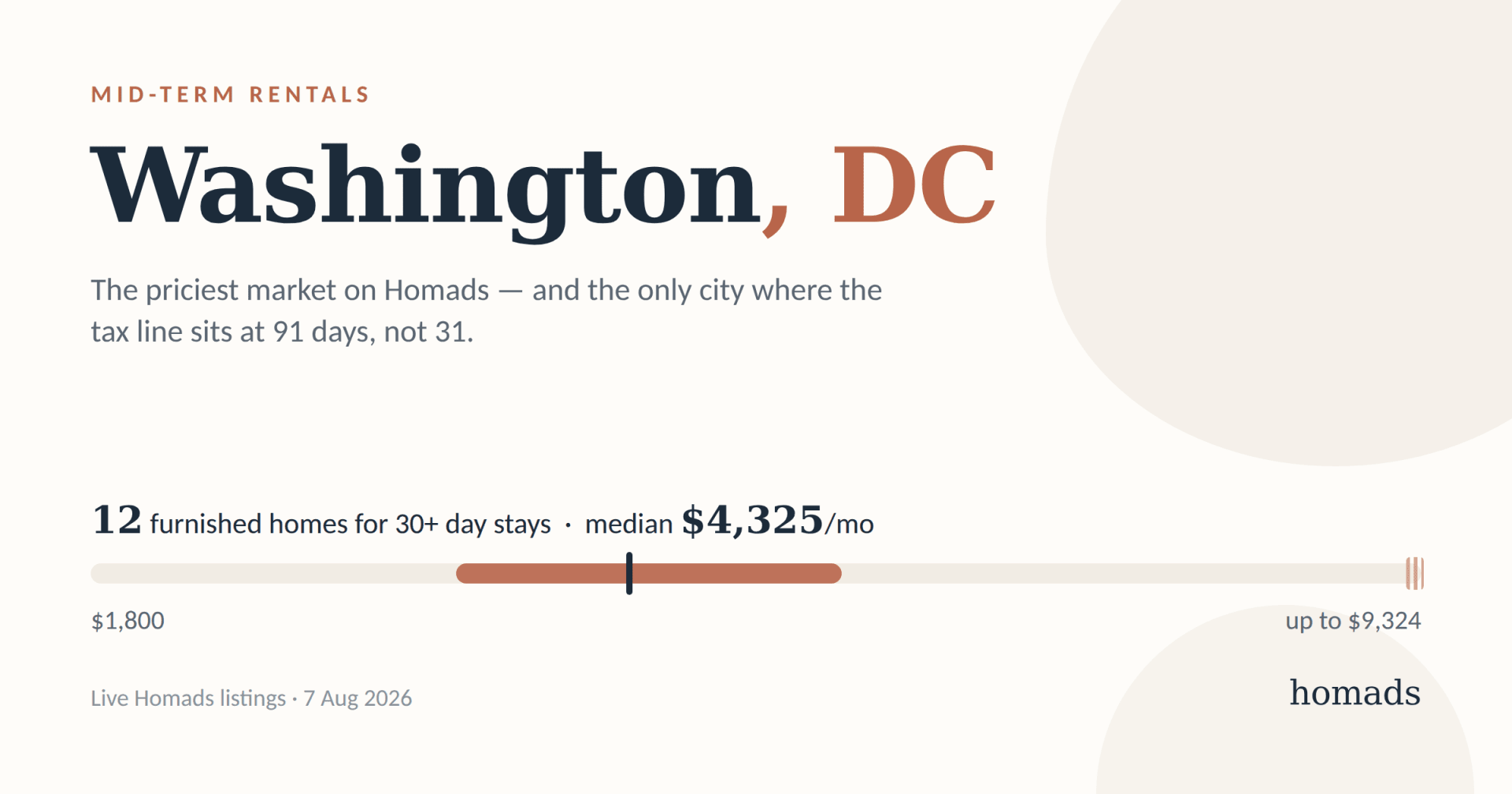
Washington has two thresholds, and they are sixty days apart.
At 31 nights you leave the short-term rental rules. The District defines a short-term rental as a stay of "30 or fewer continuous nights," so one extra night puts your host outside the licensing regime, the primary-residence requirement and the 90-night annual cap that governs un-hosted rentals here.
The tax does not move until 91 days. The District defines a transient as anyone who "occupies, or has the right to occupy, any room or rooms, lodgings, or accommodations for a period of 90 days or less during any one continuous stay." Below that line you pay 15.95% — the steepest lodging tax of any city we have written about.
So a one-month stay in Washington escapes the rules and pays the tax anyway. On the $4,325 median that is about $690 a month, and it does not stop until day 91.
If your assignment is roughly three months — and in this city an enormous number of them are — the difference between booking 89 days and booking 91 is worth over $2,000. Book the 91.
What a month actually costs
On 7 August 2026 there were 14 places listed on Homads for 30+ day stays inside Washington, from eight owners.
Thirteen are entire homes. Twelve of them carry a price, running from $1,800 to $9,324 a month, with the middle at $4,325. Half sit between roughly $3,513 and $5,325.
One is a private room, at $1,600, on Galloway Street NE in Northeast.
That median is the highest of any city in this series, and the spread is wide enough that the median is doing less work than usual. Look at the ends instead.
The bottom. A one-bedroom condo at $1,800 on 29th Street SE in Southeast, and a two-bedroom apartment at the same address for $2,500. Those two are genuinely cheap for this city and they are east of the river, which is the trade.
The top. A three-bedroom house on North Capitol Street at $9,324 and a two-bedroom rowhome on O Street NW at $8,940.
And the middle is Capitol Hill. Five of the fourteen sit in ZIP 20003, and three of those five are units at a single address on Independence Avenue SE — two-bedrooms at $4,400 and $4,600, and a four-bedroom at $7,500. Two more are studios at one address on East Capitol Street NE, at $3,250 and $4,250.
Against the conventional market, RentCafe put the Washington apartment average at $2,446 as of 1 August 2026 — down 3.77% year over year, one of the sharper falls in the country — with a studio at $1,821, a one-bedroom at $2,302 and a two-bedroom at $3,090. Furnished monthly homes ask well over that, but the gap here is partly a mix effect: this set is heavy on houses, townhouses and multi-bedroom units rather than the studios and one-beds that dominate the apartment average.
Two more things worth knowing.
Small units are scarce and not cheap. Three of the fourteen are studios, and two of those ask $3,250 and $4,250. If you are one person on a three-month posting, Washington will cost you more than any other city on this list.
The stock is spread thin. Fourteen listings across eight ZIP codes, with only Capitol Hill clustering. There is no second neighbourhood to fall back on.
Numbers move. Everything above came off the live listings on 7 August 2026 — worth checking the current set before you plan around it. That page pulls a radius rather than the city limits, so it shows more, including Virginia and Maryland.
Where to stay, depending on why you're here
Capitol Hill. ZIP 20003 — five of fourteen, and the obvious answer if your work is on the Hill, at a committee, an agency headquarters downtown, or one of the museums. Two addresses account for all five. Prices from $3,250 for a studio to $7,500 for a four-bedroom.
Northwest, near Bloomingdale and Shaw. 20001. One listing, a two-bedroom rowhome on O Street NW at $8,940.
H Street and near Northeast. 20002. One listing, a three-bedroom on Pickford Place NE at $3,600 — the best value among the larger places on this list.
Dupont Circle. 20009. One studio at $3,850, which the host describes as in the heart of Dupont. The most central address here and priced accordingly.
Up North Capitol Street. 20011, in Brightwood Park, north-west of the centre. Two listings at the same North Capitol Street NW address, including the $9,324 three-bedroom.
Northeast, near Catholic University. 20017. The single private room, on Galloway Street NE at $1,600, and the cheapest way to be in Washington by a wide margin.
East of the river. 20020, covering the Twining area of Southeast. Two listings at one 29th Street SE address, at $1,800 and $2,500 — the two cheapest entire places in the city.
Far Northeast. 20019. One three-bedroom townhouse on 47th Street NE at $4,600.
A note on the map that matters more here than almost anywhere. Washington is small and the Metro is good, but the region's employment is not mostly in the District. If your work is at NIH in Bethesda, the Pentagon or Crystal City in Arlington, Tysons, or a contractor park in Fairfax or Prince George's County, none of these fourteen is convenient and you should search Maryland or Virginia directly.
Why 31 days and 91 days both matter
This is the only city on this list where the two lines are in different places, so it is worth being precise.
The licensing line is 31 nights. The District's short-term rental regime — a licence, a primary-residence requirement tied to the Homestead Deduction, and a 90-night-a-year cap on un-hosted "vacation rentals" — applies to stays of "30 or fewer continuous nights." A stay of 31 nights or more is simply not a short-term rental in the District's eyes. That is why furnished monthly places can exist here at all, and why several of these listings are whole rowhouses rather than someone's spare room.
The tax line is 91 days. D.C. Code § 47-2001 defines a transient as a person who "occupies, or has the right to occupy" accommodations "for a period of 90 days or less during any one continuous stay." Everything at or under 90 days carries the 15.95% sales and use tax on transient accommodations — a rate that rose from 14.95% on 1 April 2023 and is set to run to 30 March 2027.
The good news is in the phrase "or has the right to occupy." As in several other jurisdictions, that language means the clock is measured by your entitlement, not by nights already slept. A signed agreement for 91 days or more should take you outside the definition of a transient from the start rather than at the end. Get the length in the document, before you arrive, and ask the host to confirm how they are treating the tax.
What this means in practice. Ninety days is the length of a great many Washington postings — a fellowship, a detail, a session, a contract quarter. Ninety days is also exactly the wrong number. Ask for 91.
One thing to be aware of on the other side. The District has unusually strong tenant protections, and a genuine residential tenancy here is not easy for a landlord to end. That cuts both ways: it is a reason some hosts prefer stays that stay short, and a reason to read carefully what you are actually signing rather than assuming the label on the listing is the legal reality.
Nothing here is legal or tax advice, and rates and rules change. Check the current position before relying on it.
Does the time of year matter?
Washington runs on a calendar, and it is not the tourist one.
Congress. The House and Senate schedules drive an enormous amount of short-notice housing demand. The long August recess is the quiet month; September through December and January through July are when the city is full.
Interns and fellows. Summer brings a large, predictable wave of people needing furnished rooms from roughly late May to mid-August, and it clears out sharply after that. If your stay starts in September you are shopping in a much easier market than someone starting in June.
Cherry blossoms. Late March to early April, and the single worst two weeks of the year to be arranging anything in this city.
Otherwise: summers are hot and very humid, winters are mild by northern standards with occasional snow that shuts the region down, and spring and autumn are excellent.
Who's actually renting here
Government and the people around it — but read this part carefully. Washington's core industry has contracted sharply. Federal employment in the Washington metropolitan area has fallen from roughly 375,800 to 312,500 since early 2025 — a loss of over 63,000 positions and the lowest level in three decades, with 54,500 of those lost in the year to May 2026 alone. One regional official described the scale as "the equivalent of losing a dozen HQ2s" in a single year.
That matters to you in two directions. There are fewer people arriving on federal details and contractor assignments than there were two years ago — and the rental market has loosened accordingly, which is why the city's average rent is down nearly 4% year over year. If you are coming to Washington now, you have more leverage than you would have had.
Congressional and campaign staff. Sessions, committee work and the two-year election cycle produce a constant churn of people who need somewhere for a few months and know exactly when they are leaving.
Legal, policy and advocacy secondments. Law firms, trade associations, think tanks and NGOs rotate people through Washington on fixed terms.
Medical trainees. Georgetown, George Washington, Howard, MedStar and Children's National all run rotations, and NIH in Bethesda draws fellows from everywhere — though, as above, NIH is in Maryland.
People landing before they commit. Washington's neighbourhoods and its Maryland and Virginia suburbs are a genuinely complicated choice, and a furnished quarter is a cheap way to make it properly.
None of them knows their exit date precisely. That is the whole reason this category exists.
Where to start
Look at what is currently listed in Washington. Work out first whether your commute actually points at the District or at Bethesda, Arlington or Fairfax, because that changes everything. Then, if there is any chance your stay runs near three months, ask for 91 days rather than 90 — it is the cheapest $2,000 you will ever save. If the category is new to you, what mid-term rentals are is the shorter explanation.
Listing counts and prices were read from live Homads data on 7 August 2026 and will have changed. Tax rates, the transient definition and the licensing thresholds were checked the same day against the D.C. Code, the D.C. Office of Tax and Revenue and the Department of Licensing and Consumer Protection.