
In San Francisco, thirty days is not a tax threshold. It is the day you stop being a guest and become a tenant.
California treats occupancy of more than 30 consecutive days as a tenancy rather than transient lodging — Revenue and Taxation Code § 7280 defines transient occupancy as "30 days or less," and Civil Code § 1940 gives landlord-tenant protections to everyone renting a dwelling unit except those in transient occupancy. Cross that line while paying your rent, and you acquire an eviction process, notice periods and the rest of it.
That is very good for you and complicated for your host, and it explains almost everything about the shape of this market.
What a month actually costs
On 7 August 2026 there were 15 places listed on Homads for 30+ day stays inside San Francisco, from five owners. The striking thing is the split.
Nine are private rooms, from $1,550 to $5,250.
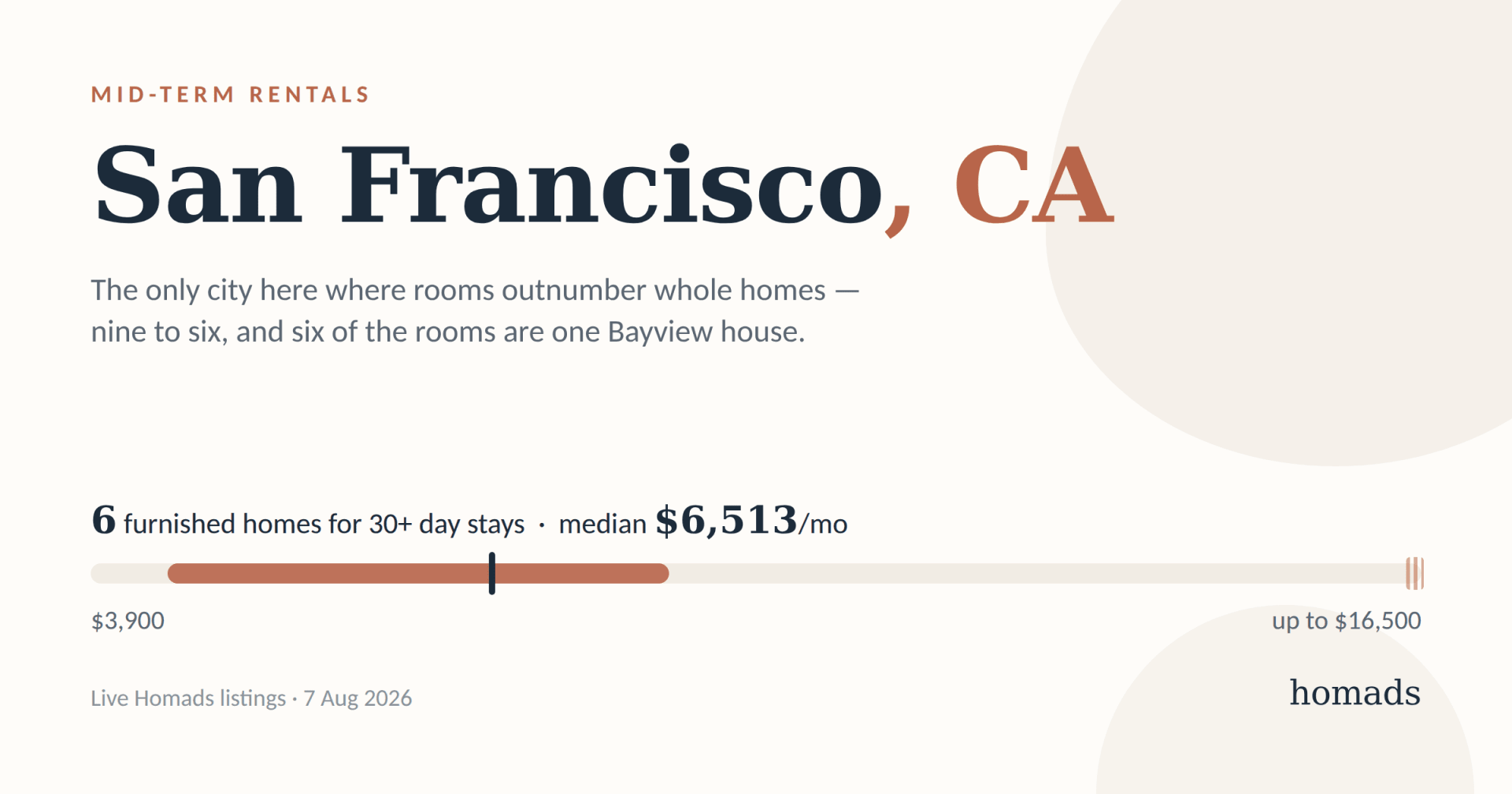
Six are entire homes, from $3,900 to $16,500, with the middle at $6,513.
San Francisco is the only city in this series where rooms outnumber whole places, and it is not close. That is the honest headline: here, sharing is not the budget compromise, it is the main product. The cheapest whole apartment in the city is $3,900. The cheapest room is $1,550. If your budget is under about $4,000, San Francisco has rooms and nothing else.
And six of the nine rooms are one house. All six are units at 3212 Ingalls Street in Bayview, listed as Bayhaus — $1,550, $1,650, $1,650, $1,700, $2,000 and $2,100, with parking, laundry and weekly cleaning. That single address is, in practice, the affordable end of San Francisco's furnished monthly market.
The other three rooms: two at a Hearst Avenue address in the Sunnyside area — a studio at $2,500 and a one-bedroom guest suite at $5,250 — and a studio on Octavia Street in the Marina at $2,800.
The whole-home end is small and expensive. Two one-bedroom apartments at the same Dolores Street address in the Mission, at $3,900 and $4,000. A two-bedroom on Duncan Street toward Noe Valley at $5,600. A one-bedroom on 2nd Avenue in the Inner Richmond at $7,425. A two-bathroom place on Hearst Avenue at $7,750. And a three-bedroom townhouse on Fell Street by the Panhandle at $16,500.
Twelve of the fifteen are one-bedrooms or single rooms. There are two two-bedrooms and one three-bedroom in the entire city set. If you are moving a family here, this is not the inventory for it.
Numbers move. Everything above came off the live listings on 7 August 2026 — worth checking the current set before you plan around it. That page pulls a radius rather than the city limits, so it shows more, including the Peninsula and the East Bay.
Where to stay, depending on why you're here
Bayview. ZIP 94124 — six of fifteen, all at the Bayhaus address, and the whole cheap end of the city. Southeast San Francisco, a long way from downtown by feel but reasonably placed for the 101 and for the biotech and hospital jobs at Mission Bay. If you want to be in San Francisco for under $2,200 a month, this is the answer.
The Mission and Noe Valley. 94110 — three listings, and the best of the entire homes. Two one-bedrooms on Dolores Street at $3,900 and $4,000, facing Dolores Park, and a two-bedroom near Duncan Street at $5,600. Central, walkable, on BART, and about as good a place to spend three months in this city as the list offers.
Sunnyside and the outer Mission district. 94112 — three listings at one Hearst Avenue address: a $2,500 studio room, a $5,250 guest suite and a $7,750 whole place. Southwest, quieter, near City College and the 280.
NOPA and the Panhandle. 94117. The $16,500 three-bedroom townhouse on Fell Street.
Inner Richmond. 94118. A one-bedroom on 2nd Avenue at $7,425, near Golden Gate Park and a short hop from UCSF Parnassus.
The Marina. 94123. The $2,800 Octavia Street studio room — the only listing in the northern half of the city.
A note on where the work is. San Francisco's largest employers are not evenly spread. UCSF has campuses at Parnassus in the west and Mission Bay in the east; the hospitals cluster around both. Downtown and SoMa hold the finance and legal work; Mission Bay holds most of the biotech. None of these fifteen listings is downtown. And if your job is actually in Palo Alto, Mountain View or San Jose, San Francisco is an hour each way and you should search the Peninsula directly.
Why 30 days is the line that matters
Three things change at thirty days here, and only one of them is about money.
You become a tenant. This is the big one. California's transient occupancy definition stops at 30 days, and past that point Civil Code § 1940's landlord-tenant protections apply — formal eviction process, notice requirements, protection against lockouts. San Francisco layers its own rent and eviction ordinances on top of state law, and the city's protections are among the strongest in the country.
This is the real reason the market you are looking at is nine rooms and six apartments rather than a hundred apartments. A San Francisco owner who lets someone occupy a whole unit for months is knowingly creating a tenancy in a city where ending one is difficult and expensive. Some owners will not do it at any price. The ones who will are the ones on this list, and they price accordingly.
The tax stops. San Francisco's Transient Occupancy Tax is 14%, and anyone receiving rent "for a stay of fewer than 30 days" must collect it. A stay of 30 days or more is occupancy by a permanent resident and falls outside it. On the $6,513 whole-home median that is about $912 a month you do not pay — one of the largest monthly tax savings of any city in this series, simply because the underlying rents are so high.
The short-term rental rules stop applying to your host. San Francisco's registration regime — a Business Account Number, Office of Short-Term Rentals registration, a requirement that the host has lived in the unit for at least 60 days and plans to live there at least 275 nights a year, and a 90-night annual cap on un-hosted rentals — governs stays under 30 nights. At 30+ your host is not running a short-term rental at all.
The practical instruction. Get the length in writing before you arrive, and read the agreement properly — because in this city, unusually, the document is creating real rights on both sides. If a host offers you a 28-day stay and suggests re-booking, understand that the purpose of that structure is to stop you acquiring tenancy, and decide whether you mind.
Nothing here is legal advice, and rates and ordinances change. Check the current position before relying on it.
Does the time of year matter?
Less than the weather reputation suggests, and more than the calendar does.
The fog. San Francisco's coldest, greyest stretch is July and August, not winter. If you are picturing California summer, the Sunset and the Richmond in August will surprise you. September and October are the genuinely warm, clear months, and they are the best time to be here.
Rain. Roughly November to March, and effectively nothing in between.
Microclimates are real and they matter for a three-month stay. Bayview and the Mission — where most of these listings are — are among the sunniest and warmest parts of the city. The Richmond, the Sunset and the Marina are cooler and foggier. That is not a small difference over a quarter.
Conferences. The big ones — JPMorgan Healthcare in January, Dreamforce in the autumn, and the game and developer conferences in spring — compress hotel supply for a week at a time. A monthly rate agreed in advance sits outside all of it.
Who's actually renting here
Biotech and health sciences. UCSF and the Mission Bay cluster around it run on postdocs, fellows and project scientists on defined terms, and the companies nearby run on contract work. This is the steadiest source of mid-term demand in the city.
Traveling clinicians. UCSF, Zuckerberg San Francisco General, CPMC and the VA all take thirteen-week contracts.
Technology, on shorter terms than it used to be. The industry that made this city expensive now brings a lot of people in for weeks and months rather than moving them permanently — visiting engineers, fixed-term researchers, teams in for a launch. A furnished quarter fits that better than a lease.
People testing the city. San Francisco is a place a lot of people arrive committed to and leave uncertain about, or the reverse. Seven square miles of very distinct neighbourhoods is a lot to judge from outside, and $1,550 for a room in Bayview is a far cheaper experiment than a year in the wrong one.
None of them knows their exit date precisely. That is the whole reason this category exists.
Where to start
Look at what is currently listed in San Francisco, and start by deciding whether a room works for you — because if it does, your budget here is about $1,600 to $2,800, and if it does not, it is $3,900 and up with very little in between. Check the microclimate of the neighbourhood you are considering, not just the commute. And read whatever you sign, because thirty days in California is a legally meaningful line. If the category is new to you, what mid-term rentals are is the shorter explanation.
Listing counts and prices were read from live Homads data on 7 August 2026 and will have changed. Tax rates, the transient occupancy definition and the registration rules were checked the same day against the California Civil Code, the California Revenue and Taxation Code, the San Francisco Treasurer & Tax Collector and SF.gov.