
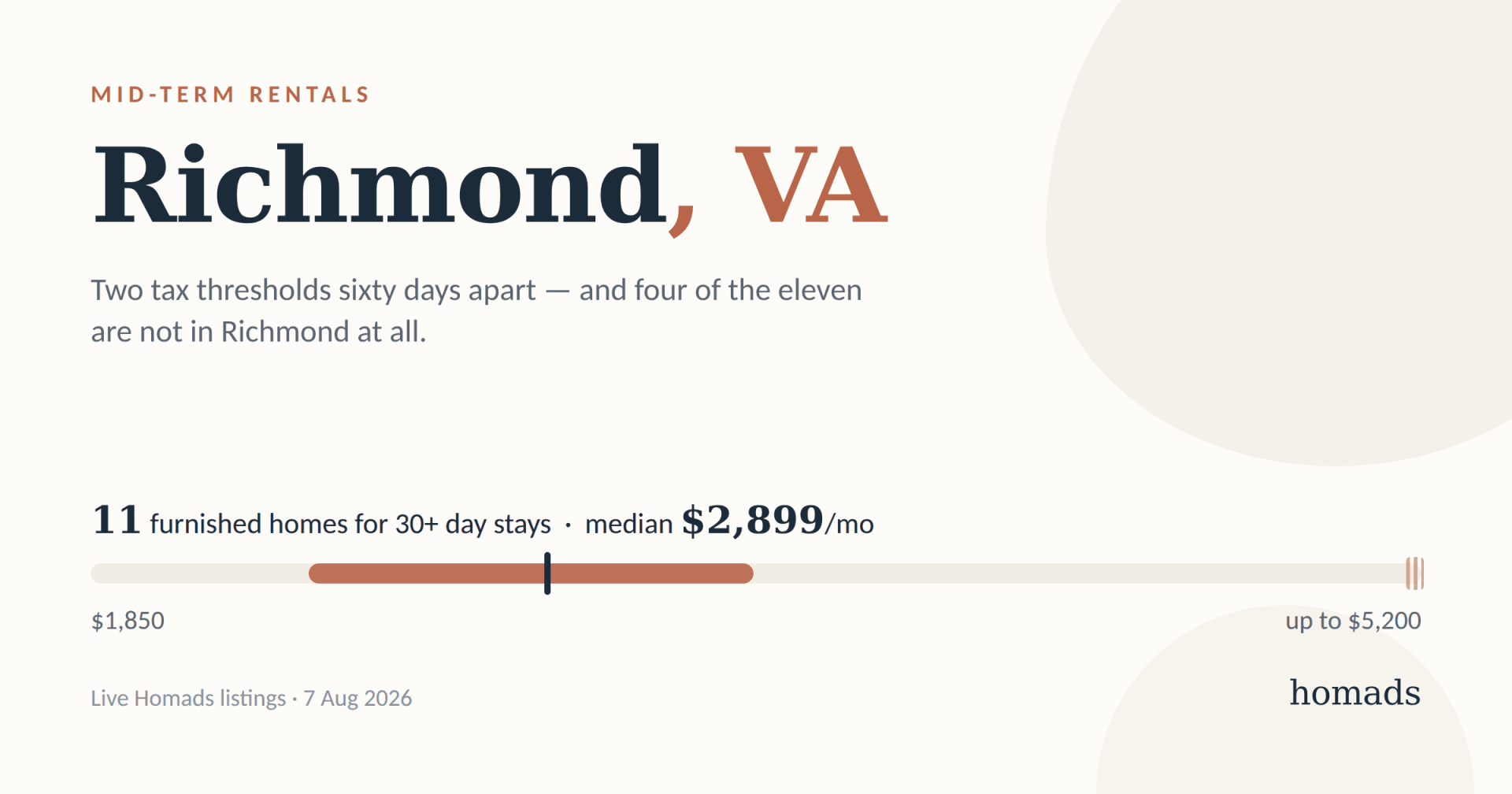
Richmond has two lodging tax thresholds, sixty days apart, and almost every guide quotes only the first one.
At 30 continuous days the city's 8% lodging tax stops. Virginia Code § 58.1-3819(B) is explicit: the tax "shall not apply to rooms or spaces rented and continuously occupied by the same individual or same group of individuals for 30 or more days."
But the 6% sales tax runs to 90. Virginia taxes accommodations "furnished to transients for less than 90 continuous days" — § 58.1-602. So a sixty-day stay in Richmond has cleared the famous thirty-day line and is still being taxed.
Combined, a short stay carries about 14%. Between 30 and 89 days you pay 6%. Past 90 you pay nothing.
And there is a second, larger reason to care about that same 90-day number — it decides whether you have any tenant rights at all. That is further down, and it is the most important thing on this page.
What a month actually costs
On 7 August 2026 there were 11 places listed on Homads for 30+ day stays around Richmond, from seven owners. All eleven are entire homes.
Prices run from $1,850 to $5,200 a month, with the middle at $2,899. Half sit between roughly $2,350 and $3,373.
But four of the eleven are not in Richmond. More on that below — it matters more here than in any city we have written about.
Against the conventional market, RentCafe put the Richmond apartment average at $1,630 as of 1 August 2026, up 3.45% year over year — one of the faster increases in this series. A studio averages $1,398, a one-bedroom $1,497, a two-bedroom $1,687, a three-bedroom $2,145.
Look at how flat that curve is. Ninety-nine dollars separates a studio from a one-bedroom. Another $190 buys a second bedroom. Richmond is one of the few cities where sizing up costs almost nothing — and the furnished market reflects it. The gap between the $1,850 studio downtown and the $3,400 three-bedroom house with a yard is $1,550 a month for two extra bedrooms and outdoor space.
A gap worth noticing. Five of the eleven are one-bedrooms or studios, four are three-bedrooms and two are four-bedrooms. There is not a single two-bedroom in the city set. If that is what you want, you are choosing between paying for a bedroom you will not use or making do with one.
Numbers move. Everything above came off the live listings on 7 August 2026 — worth checking the current set before you plan around it.
Where to stay — and the county line that matters
Virginia runs an unusual system: independent cities are legally separate from the counties around them. Richmond city is not part of Henrico or Chesterfield. A "Richmond, VA" mailing address proves nothing about which jurisdiction you are in — and that decides the tax ordinance you fall under, whose short-term rental rules apply, and whose police and code enforcement you would call.
Inside Richmond city — seven of the eleven.
Shockoe Bottom and Church Hill. ZIP 23223 — four listings, the largest cluster, three of them at one Cedar Street address: a studio at $1,850 (the cheapest place in the set), a one-bedroom at $2,000, and a three-bedroom triplex unit at $3,000 the host describes as walkable to bars. The fourth is a three-bedroom on North 19th Street at $3,400 with a yard. This is the walkable, historic, close-to-downtown part of the city and it is where you should start.
The Fan and Monument Avenue. 23220 — two listings, a one-bedroom on Blair Street at $2,200 and another on South Rowland Street at $2,500 the host calls close to everything. Richmond's most characterful neighbourhood, and close to VCU.
Downtown. 23219. A fully furnished executive loft on Oliver Hill Way at $2,600, utilities included — the closest thing on this list to a walk-to-the-Capitol option.
Outside Richmond city — the other four, and they are not cheap.
A three-bedroom townhouse on Covemeadow Drive, 23238, at $2,899 — that is Henrico County. A four-bedroom on Tuxford Road, 23236, at $3,345, which the host titles Corporate Relocation — Chesterfield County. A four-bedroom on Cochise Trail, 23237, at $5,200 — also Chesterfield. And a three-bedroom on West Rois Road, 23227, at $5,200 — Henrico again.
None of those is a bad property. But if you chose Richmond for the Fan, for walkability, or for being near VCU Medical Center, they are suburban houses ten to fifteen miles out and you will need a car. Both of the $5,200 listings — the two most expensive in the set — are outside the city.
Where the work is. VCU Health (13,500 employees) and VCU itself (7,832) are downtown and in the Fan, which is why 23219, 23220 and 23223 are the ZIPs that matter for anyone in healthcare or at the university. Capital One (14,000) is in Henrico's West End. HCA Virginia (11,200) is spread across the metro.
Why 90 days is the number to care about
Two separate rules land on 90 days, and together they change everything about how you should book.
The tax, restated plainly. Under 30 days: about 14% (8% city lodging plus 6% state and local sales tax). From 30 to 89 days: 6%. From 90 days: nothing. On a $2,899 month, that 6% is about $174 — small, but it runs for three months if you do not clear the line.
The tenancy rule, which is the big one. Virginia's Residential Landlord and Tenant Act says at § 55.1-1201(D)(3) that if a person resides in "a hotel, motel, extended stay facility… for 90 consecutive days or less, such lodging shall not be subject to the provisions of this chapter."
Then (D)(4) gives you the way out. It applies the Act to a person who resides in such a facility "for more than 90 consecutive days or is subject to a written lease for more than 90 days."
That "or" is the whole game. You do not have to complete ninety days. A written lease for more than ninety days makes you a protected tenant from day one.
And here is the part that ties both rules together. Neither the 8% lodging tax, the 6% sales tax, nor the 90-day VRLTA exclusion applies to an ordinary residential apartment lease from a residential landlord. All three are about hotels, extended-stay facilities and short-term rental operators. Rent an apartment on a proper lease and you are outside all of it — no lodging tax, no sales tax, and full tenant protection at any length.
So the single most useful decision in Richmond is not how long you book. It is who you rent from. An apartment on a written residential lease beats an extended-stay room on every dimension at once. If it has to be extended-stay, sign for 91 days.
The short-term rental rules, which stop before you. Richmond defines a short-term rental as "the rental of rooms in a dwelling unit for less than 30 consecutive days," requires the operator's primary residence — occupied at least 185 days a year — and a Certificate of Zoning Compliance renewed every two years at $300. There is no non-primary category at all; an owner who does not live there must go through a discretionary Special Use Permit. That strictness is exactly why furnished monthly inventory exists here: for a non-resident owner, 30+ days is the only lawful route.
Nothing here is legal or tax advice, and rates and rules change. Check the current position before relying on it.
Does the time of year matter?
More than almost anywhere, and for a reason unique to a state capital.
The General Assembly. Virginia's constitution fixes the convening date at the second Wednesday in January. The 2026 session ran 14 January to 14 March. The 2027 session will convene 13 January 2027; as an odd-numbered year the constitutional limit is thirty days, though the Assembly routinely extends by two-thirds vote, so expect it to run into late February.
For those weeks, 140 legislators plus staff, lobbyists, agency personnel and press arrive in downtown Richmond needing exactly the product you want — a furnished place for one to three months. It is one of very few American cities with a legislature-driven mid-term rental season, and it maps precisely onto this window.
What to do about it. Mid-January to early March is the worst time to rent here, and 23219 and 23220 — the walk-to-the-Capitol ZIPs — take the brunt. Book a January start by October. Conversely, mid-March through May is the best window of the year: session inventory returns to the market all at once, often from owners who have just lost a premium tenant and will negotiate.
August is the second squeeze, when VCU returns.
Summer is hot and genuinely humid from June into September. Much of the Fan and Church Hill housing stock is pre-war, so confirm central air conditioning explicitly rather than assuming. Summer is otherwise a soft season — legislature gone, students gone — so it is good value if you can take the heat.
October to mid-December is the best combination of weather and price in the year.
Who's actually renting here
Healthcare, above everything. VCU Health at 13,500 and HCA Virginia at 11,200 are nearly 25,000 jobs between them. VCU Medical Center is an academic Level I trauma centre downtown, which means a continuous flow of residents, fellows, rotating students, locums and travel nurses on three-to-twelve-month assignments. This is the steadiest, least seasonal source of demand in the city and it concentrates in exactly the ZIPs above.
State government and the session. Six to eight weeks a year of very concentrated, very predictable demand.
CoStar, which is the growth story. The company employs about 2,400 in Richmond and announced in early 2025 that it expected to hire a further 1,000 people, predominantly in Richmond, to support Homes.com — roughly a 40% increase concentrated in one city, alongside an expanded downtown campus. Relocating new hires need sixty to ninety days of furnished housing while they find somewhere permanent, and they are competing with you for it.
Corporate secondments. Richmond is unusually dense in corporate headquarters for its size — Capital One, Dominion, CarMax, Markel and others — which brings consultants, auditors and interim executives on fixed terms.
People landing before they commit. Richmond is cheap by East Coast standards and its neighbourhoods vary sharply. A furnished quarter is a cheap way to find out whether you want the Fan, Church Hill, or somewhere over a county line entirely.
None of them knows their exit date precisely. That is the whole reason this category exists.
Where to start
Look at what is currently listed around Richmond. Check the ZIP against the county line before anything else — four of these eleven are in Henrico or Chesterfield, including both of the most expensive. Prefer an apartment on a written residential lease over an extended-stay room, because that one choice decides both your tax and your legal rights. And if your stay might run near three months, write it for 91 days. If the category is new to you, what mid-term rentals are is the shorter explanation.
Listing counts and prices were read from live Homads data on 7 August 2026 and will have changed. Tax rates, the two thresholds and the tenancy wording were checked the same day against the Code of Virginia, the City of Richmond and the Virginia Constitution.