
In Portland, the thing that removes the tax is not the length of your stay. It is how you are billed.
Portland's code exempts anyone staying "more than 30 successive calendar days" — day 31 — but it then adds a clause almost nobody quotes. A person who pays for lodging "on a calendar month basis, irrespective of the number of days in such a month, will not be deemed a transient" (City Code 6.04.050.A). That is a status test, not a duration test. Billed monthly, you are not a transient at all, and the 13% never appears.
The city's own plain-English guidance describes something different: pay for the first thirty days, then claim a refund or credit once you reach day 31.
Both are on portland.gov. The ordinance is the ordinance. Ask to be billed monthly, in advance, on a month-to-month agreement — and ask before you arrive, because the difference between those two readings is about $345 a month on the median.
What a month actually costs
On 7 August 2026 there were 13 places listed on Homads for 30+ day stays inside Portland, from seven owners.
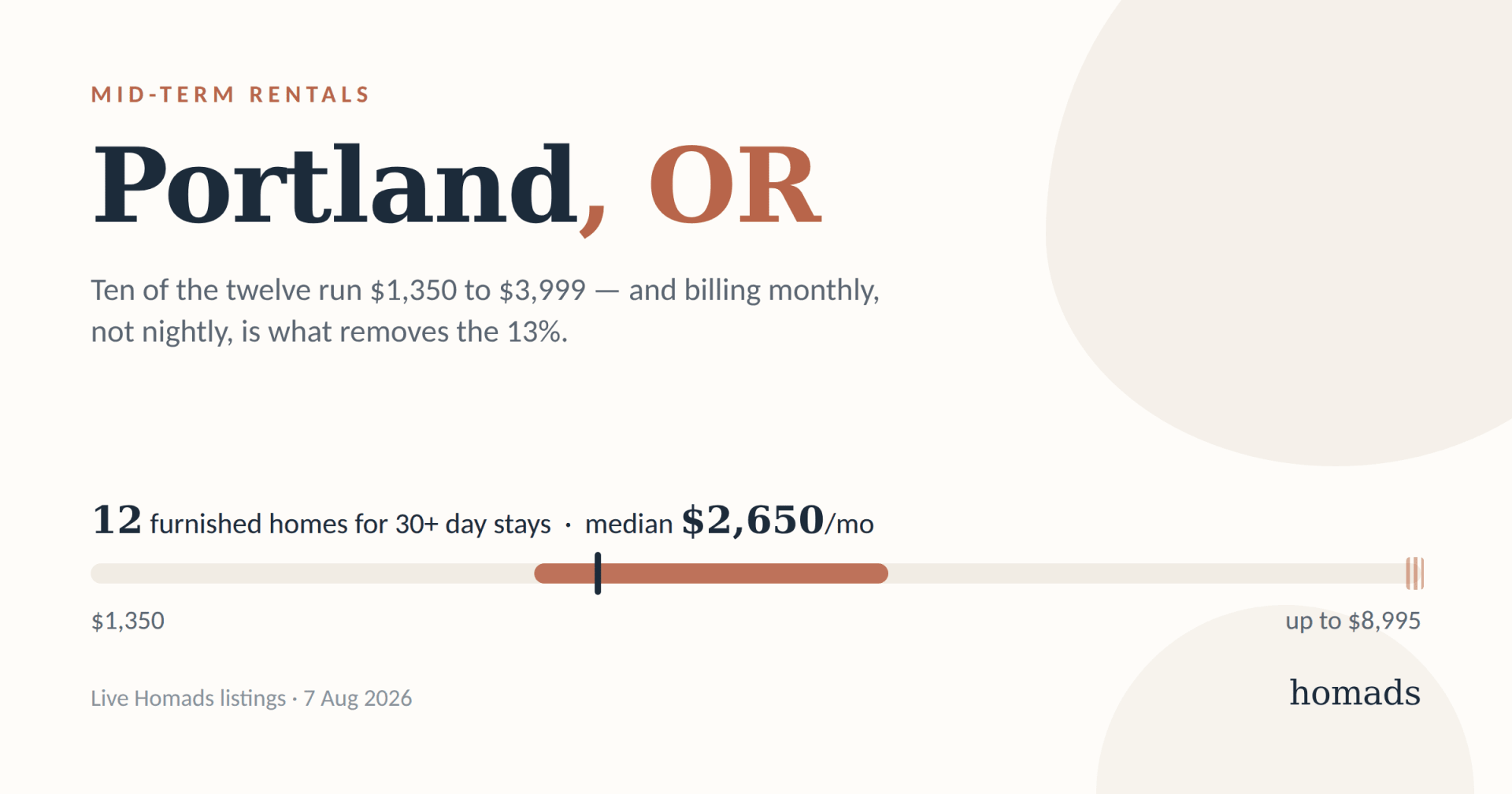
Twelve are entire homes with a price, running from $1,350 to $8,995 a month, with the middle at $2,650. Half sit between roughly $2,488 and $3,400.
The thirteenth is a private room in the lower level of a townhouse in south-east Portland, listed without a price — worth asking about, because it is the only shared option in the city.
Ignore the top two. A four-bedroom in north-east Portland at $7,500 and another on the north-west edge at $8,995 are executive houses. Strip them out and the remaining ten run $1,350 to $3,999, which is the range you will actually shop in — and it is one of the cheaper working ranges in this series.
Against the conventional market, RentCafe put the Portland apartment average at $1,708 as of 1 August 2026, down about 1.6% year over year — a studio at $1,326, a one-bedroom at $1,621, a two-bedroom at $1,963. The furnished monthly middle is roughly 1.6 times the one-bedroom average, one of the narrower premiums we have measured.
Two more things about the shape of this set.
It is a one-bedroom market. Eight of the thirteen are one-bedrooms or studios. Two are two-bedrooms, one is a three, and the only two four-bedrooms are the two most expensive places in the city. If you are one person on a contract, Portland is well supplied. If you are moving a family, there is one realistic option under $7,000.
The cheapest thing here is genuinely cheap. A studio ADU on North Vancouver Avenue at $1,350 is below the city's average studio rent — furnished, by the month, with no year's lease. That is unusual and it will not last.
Numbers move. Everything above came off the live listings on 7 August 2026 — worth checking the current set before you plan around it. That page pulls a radius rather than the city limits, so it shows more.
Where to stay, depending on why you're here
Nob Hill and the Alphabet District. ZIP 97209 — three listings, the largest cluster. A one-bedroom on North-West Davis Street at $2,500, and two at one address on North-West Flanders Street, a studio at $2,500 and a flat at $2,800, both of which the host describes as steps from 23rd Avenue. This is the most walkable part of this list and the easiest place to spend three months in Portland without a car.
Mount Tabor and Hawthorne. 97215 — two listings at opposite ends: a sunny studio on South-East Stark Street at $2,000, and a three-bedroom pet-friendly house on South-East Hawthorne Boulevard at $3,999.
South-west, along Capitol Highway. 97219 — two apartments in the same building at 6630 and 6640 South-West Capitol Highway, at $2,800 and $2,500, both ground floor with a balcony.
Sellwood. 97202. A cottage on South-East Tacoma Street at $3,200, walkable to the shops.
North Portland. 97217 and 97227 — the $1,350 studio ADU on North Vancouver Avenue and a modern apartment on North Longview Avenue at $2,450. Between them these are the two best-value whole places in the city.
North-east. 97211. The $7,500 four-bedroom on North-East 14th Place.
Two address warnings.
The first: the $8,995 four-bedroom is on North-West Edgebrook Place in 97229 — a ZIP that carries a Portland mailing address but which extends well past the city line into Washington County, out toward Cedar Mill and Bethany. If being inside Portland proper matters to you — for the lodging tax, for the city's tenant protections, for anything jurisdictional — check that specific parcel.
The second, and more useful: 97219 also contains Dunthorpe, an unincorporated pocket just south of the city limits. It is a small area and the two Capitol Highway listings are almost certainly not in it, but the principle holds — in Portland a mailing address is not a municipal boundary.
And the biggest placement note. Portland's largest employers are not evenly spread, and two of the most famous ones are not in Portland at all. OHSU (20,882 employees) is on Marquam Hill and in South Waterfront, inside the city. Providence (19,221) and Legacy (14,000) are also in Portland. But Nike is in Beaverton and Intel is in Hillsboro — both in Washington County, both roughly twenty miles west, and neither reachable comfortably from most of this list. If your job is at either, search those suburbs directly.
Why 30 days, 31 days, and monthly billing all matter
Portland stacks three separate rules and they do not line up.
The tax, and the clause worth knowing. A short stay carries 13% — 6% City of Portland transient lodgings tax, 5.5% Multnomah County, and 1.5% Oregon state. (Oregon has no sales tax at all; this lodging levy is the only consumption tax on your rent.) City Code 6.04.010 defines a transient as someone occupying "for a period of 30 consecutive calendar days or less," and 6.04.050.A exempts "any occupant for more than 30 successive calendar days" — plus the monthly-billing clause quoted at the top of this piece. Oregon's own rule is one day earlier: ORS 320.308 exempts "a dwelling unit that is leased or otherwise occupied by the same person for a consecutive period of 30 days or more," and the state's guidance is that once you reach 30 days the entire stay comes out, not just the tail.
So the practical instruction is: get a month-to-month agreement, billed monthly, signed before you arrive. That is the structure the ordinance exempts outright.
One rate change to diary. House Bill 4134 raises the Oregon state share from 1.5% to 2.75%. The legislature's own measure summary applies it to charges "occurring on or after January 1, 2027," which would take the combined rate to about 14.25%. It does not affect a stay booked and completed this year, but it is worth knowing if you are planning ahead.
The short-term rental rules, which do not reach you. Portland's Accessory Short-Term Rental permit covers renting bedrooms "for fewer than 30 consecutive days," and it is strict: a resident must occupy the unit at least 270 days a year, renting three or more bedrooms requires a conditional use review, and vacant or non-primary-residence units are simply not eligible. At 30+ days none of that applies. This is why a furnished whole-house market exists here at all.
And the part that is better than the tax. Oregon does not have a "guest becomes a tenant on day 30" rule — it has something considerably more useful. ORS 90.100(53) defines transient occupancy as requiring all three of: charged on a daily basis and not collected more than six days in advance; daily or every-other-day maid and linen service included; and a period not exceeding 30 days. A furnished monthly rental fails the first two immediately. So you are a tenant under Oregon's Residential Landlord and Tenant Act from day one, not from day thirty — with a real eviction process rather than a hotel lockout. ORS 90.110 also contains an anti-avoidance clause: arrangements "created to avoid the application of this chapter" do not get the exemption.
Two things that follow from being a tenant. Oregon's statewide rent cap for 2026 is 9.5%, but it governs increases within a continuing tenancy — it does not set your opening rent. And Portland requires relocation assistance of $2,900 to $4,500 depending on unit size on a no-cause termination or a rent increase of 10% or more. Neither is likely to come up in a three-month stay, but both are reasons a Portland landlord will want the paperwork right, and reasons to read what you sign.
Nothing here is legal or tax advice, and rates and ordinances change. Check the current position before relying on it.
Does the time of year matter?
The rain is real but it is about frequency, not volume. Portland gets about 31 inches a year across roughly 173 days with precipitation — less total rain than much of the East Coast, spread over far more days. The wet stretch is October through April, peaking in December at about 4.5 inches across 18 or 19 rainy days. July is the driest month at about a third of an inch.
Summer is genuinely lovely and short. August averages an 81°F high; July is close behind. June through August is the dry, warm window, and it is when this city is at its best.
The compression event is 1 July. OHSU's residents and fellows start clinical work on 1 July, with orientation from mid-June — a fixed-date cohort arriving every year needing somewhere furnished before they sign an annual lease. If your stay starts in June, July or August, book early. Portland State's autumn term begins 28 September 2026, adding a secondary bump.
January and February are the value months — wettest, quietest, and the point in the year where a monthly rate is easiest to negotiate.
Who's actually renting here
Healthcare, and it is most of the story. Four of the region's top six employers are health systems: OHSU at 20,882, Providence at 19,221, Legacy at 14,000 and Kaiser at 13,308 — roughly 67,000 jobs between them. That produces travelling nurses on thirteen-week contracts, locum physicians, and the annual July intake of residents and fellows. This is the steadiest source of furnished-month demand in the city and it is not going anywhere.
Be honest about the rest of it, though. Portland is not currently a growth story. Intel's Oregon headcount has fallen to roughly 16,000 from about 22,000, with around 6,000 Oregon jobs cut across 2024 and 2025, and the Hillsboro research expansion remains shelved. Nike announced 1,400 job cuts worldwide in April 2026, including at its Beaverton headquarters. Downtown office vacancy was 31.9% in the first quarter of 2026 — down from 33%, the first fall in nearly three years, but quarterly leasing was the lowest on record outside 2020. And the city's population is estimated at 635,109 as of mid-2025, down about 2.7% from the 2020 census.
None of that is a reason not to come. It is a reason to know that you have more negotiating room here than the listings suggest, and that rents are falling rather than rising.
Universities and visiting academics. Portland State is downtown with 5,212 staff; Reed and Lewis & Clark add smaller autumn intakes.
People trying the city on. Portland's neighbourhoods differ sharply and quickly, and the difference between Nob Hill, Sellwood and outer south-east is not obvious from a map.
None of them knows their exit date precisely. That is the whole reason this category exists.
Where to start
Look at what is currently listed in Portland. Decide whether you need a car — if you do not, Nob Hill and the inner east side are the ones to look at first. Check that the address is actually inside the city if that matters to you. And, above everything else here, ask to be billed monthly rather than nightly, and get the agreement signed before you arrive — in Portland that one detail is what decides whether you pay 13% or nothing. If the category is new to you, what mid-term rentals are is the shorter explanation.
Listing counts and prices were read from live Homads data on 7 August 2026 and will have changed. Tax rates, the transient definition and the permit rules were checked the same day against the Portland City Code, Multnomah County, the Oregon Department of Revenue and the Oregon Revised Statutes.