
Philadelphia is the one city where thirty days is the wrong number.
Almost everywhere else, a thirty-day stay puts you across the line: no hotel tax, no short-term-rental rules. Philadelphia draws its line at more than thirty. The city's Limited Lodging licence covers stays of "30 consecutive days or less." The Rental Licence is for "more than 30 consecutive days." And the city's own tax guidance says the hotel tax exemption is for someone who has stayed "31 or more days in a row."
A thirty-day booking in Philadelphia sits exactly on the wrong side of all three.
So the single most useful sentence on this page is this: sign for thirty-one days, not thirty. It costs you one night and it changes your licensing category, your tax treatment and, on a $3,285 month, about $509.
What a month actually costs
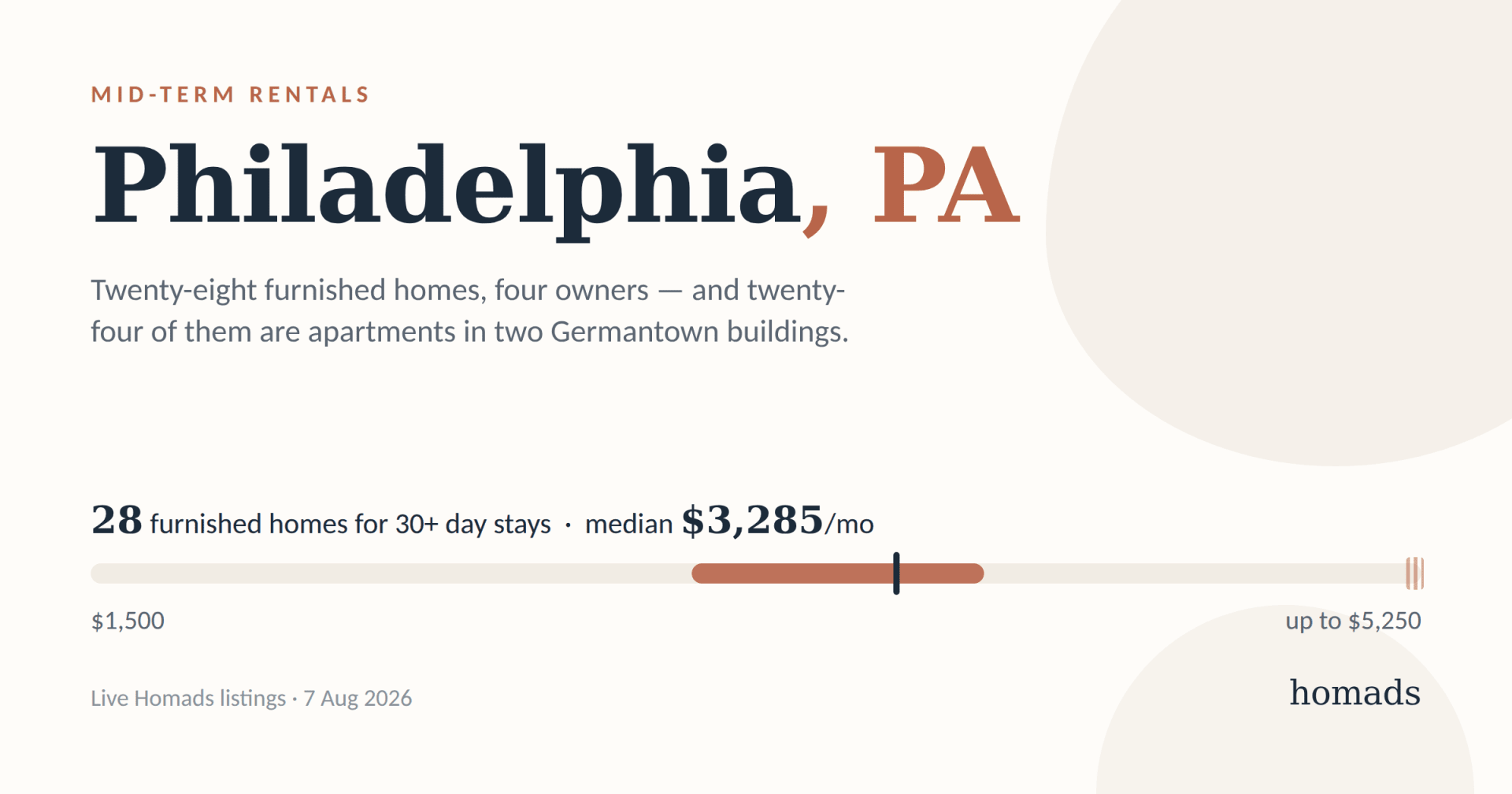
On 7 August 2026 there were 28 places listed on Homads for 30+ day stays inside Philadelphia. Every one of them is an entire home — no private rooms, no roommate arrangements anywhere in the city.
Asking prices run from $1,500 to $5,250 a month, with the middle at $3,285. Half sit between roughly $2,833 and $3,480, which is a remarkably tight band.
It is tight for a reason, and you should know the reason before you read another number.
Twenty-four of the twenty-eight are apartments in two buildings. The whole set belongs to just four owners. This is not a market in the usual sense — it is two purpose-built apartment buildings that rent furnished by the month, plus four one-off homes scattered across the city.
That is not a criticism. For a lot of mid-term renters it is actually the better product: professional management, a lease, a real building with a front desk rather than someone's spare condo. But it means "the median Philadelphia price" is mostly telling you what one landlord charges, and you should treat it that way.
Here is the honest shape of it.
5450 Wissahickon Avenue, in Germantown. Eighteen units, listed as Avenue, from $2,910 to $5,250. Fourteen are two-bedrooms, four are one-bedrooms. The listings mention a pool, a gym and parking. This is the bulk of Philadelphia's inventory on Homads and it is a single address.
236 West Walnut Lane, also in Germantown. Six units, listed as Lennox, from $1,500 to $2,550. Three studios and three one-bedrooms. At $1,500 the cheapest Lennox studio is the cheapest furnished month in the city by a clear margin.
And four singles. A one-bedroom on Market Street in Old City at $2,600. A three-bedroom in Girard Estates, South Philadelphia, at $3,800. A one-bedroom in Fairmount at $4,795. A two-bedroom in Pennsport at $5,175.
Against the conventional market, RentCafe put the Philadelphia apartment average at $2,036 as of 1 August 2026, up about 2% year over year — a studio at $1,488, a one-bedroom at $1,859, a two-bedroom at $2,350.
But the comparison that actually matters here is local. Because nearly everything is in Germantown, and RentCafe puts the Germantown average at $1,518 and neighbouring East Falls at $1,661. So the Avenue's two-bedrooms are asking roughly twice what an unfurnished Germantown apartment costs, and the cheapest Lennox studio is asking about what the average Germantown apartment costs — furnished, by the month, with no year-long lease.
Numbers move. Everything above came off the live listings on 7 August 2026 — worth checking the current set before you plan around it. That page pulls a radius rather than the city limits, so it shows more.
Where to stay, depending on why you're here
Germantown and the East Falls edge. ZIP 19144, and effectively the entire market. Northwest Philadelphia, well outside Center City, with big stone houses, the Wissahickon woods next door and a Regional Rail line into town. If you have a car or you are happy on the train, it works. If your work is in Center City and you want to walk to it, this is not that.
Old City. 19106. One listing, a one-bedroom at $2,600, and the only place on this list in the historic core. Independence Hall, the Delaware waterfront, and the part of the city visitors picture.
Fairmount. 19130. One listing at $4,795. North of Center City near the Art Museum and the parkway, and within reach of the hospital corridor on the west side.
South Philadelphia. 19145 in Girard Estates and 19148 in Pennsport, one each. Rowhouse neighbourhoods, the stadium complex to the south, and the Navy Yard beyond that.
The placement note that matters most. Philadelphia's employment is dominated by hospitals and universities, and none of the twenty-eight listings is next to any of them. Penn Medicine and the University of Pennsylvania together employ about 46,554 people locally; Jefferson about 42,700; Children's Hospital of Philadelphia 24,945; Temple 17,752. Penn, CHOP and Drexel sit together in University City on the west bank of the Schuylkill; Jefferson is in Center City; Temple is in North Philadelphia. From Germantown you are commuting to all of them.
Check the actual journey before you book, not the map distance. Philadelphia is a small city that is slow to cross.
Why 31 days is the line that matters
Three separate rules land near thirty days, and they do not agree with each other. This is worth reading slowly.
The licence. A Philadelphia host renting for "30 consecutive days or less" needs a Limited Lodging Operator License — which requires the property to be a primary residence, plus a Commercial Activity License, a BIRT tax ID, a zoning permit, lead safety certification and an inspection, at $150 a year. To rent for more than 30 consecutive days, the host needs a Rental License instead. The two buildings above operate on the second footing, which is why they can be whole buildings rather than somebody's home.
The tax. A short stay in Philadelphia carries 15.5% — 8.5% city hotel tax plus Pennsylvania's 7%. That is among the steepest rates of any city we have looked at, and unlike most of them it does not simply switch off at thirty days.
And here is the disagreement. Pennsylvania's regulation defines a permanent resident as someone who "has occupied or has had the right to occupy a room or rooms in a hotel for 30 consecutive days or more" — 61 Pa. Code § 38.3. The words "right to occupy" are doing real work: a signed lease gives you the right on day one. Section 38.2 then exempts a permanent resident for "any rental period during which, or at the expiration of which, he is or becomes a permanent resident."
But the City of Philadelphia's own plain-English guidance says the exemption applies to someone who has stayed "31 or more days in a row."
Those are not the same rule. The state regulation reads as thirty days with a lease; the city's guidance reads as thirty-one nights actually slept. You will not win that argument at check-out, and a booking platform will apply whichever it has configured.
So: thirty-one days, in writing, before you arrive. It clears the state definition, it clears the city's version of it, and it clears the licensing boundary at "more than 30." One extra night is a very cheap way to stop being a hotel guest.
One thing Pennsylvania does not give you. There is no statutory day count at which a guest automatically becomes a tenant with a tenant's protections. The thirty-day figure above is a tax definition and a licensing definition. What governs your stay is the agreement you sign, which is a reason to read it.
Nothing here is legal or tax advice, and rates and rules change. Check the current position before relying on it.
Does the time of year matter?
Less than it did three months ago, and that is the useful thing to know.
Philadelphia has just come through the busiest summer in its modern history. The city hosted FIFA World Cup matches and a fan festival at Lemon Hill, the MLB All-Star Game at Citizens Bank Park, the MLB draft at the convention centre, a PGA Tour event at Aronimink, and the Semiquincentennial — America's 250th birthday — on 4 July, in the city where it started. All of it landed between June and mid-July 2026.
It is now August. That pressure has come off, and if you were priced out of Philadelphia earlier this year, this is a different market from the one you looked at.
Otherwise the rhythm is academic. Philadelphia runs on universities and teaching hospitals, so late August and early September are when furnished stock moves, and late June is when it frees up. Winters are cold and grey rather than severe; summers are humid.
Who's actually renting here
Medical trainees and traveling clinicians, more than almost anywhere. Four of the region's five largest employers are health systems or universities attached to them. Between Penn Medicine, Jefferson, CHOP and Temple that is over 130,000 local jobs, a large share of them on fixed-length rotations, residencies, fellowships and thirteen-week travel contracts. If there is one thing Philadelphia reliably produces, it is people who need somewhere furnished for three months.
Students and postdocs on short terms. Same institutions, different contracts. A semester is four months, which is exactly the shape of this category.
Life sciences and pharma. The corridor running out to the western suburbs — Merck, Johnson & Johnson, and the cell and gene therapy cluster that grew out of Penn and CHOP — runs on project work and secondments.
People landing before they commit. Philadelphia is cheap by East Coast standards and its neighbourhoods differ sharply block to block. A furnished month is a cheaper way to find out where you belong than a year's lease in the wrong one.
None of them knows their exit date precisely. That is the whole reason this category exists.
Where to start
Look at what is currently listed in Philadelphia, and go in knowing that most of what you will see is two buildings in Germantown. Decide first whether Germantown works for your commute — if it does, this is a straightforward, well-supplied market at a fair price. If it does not, widen the search before you narrow it. And whatever you book, put thirty-one days in writing. If the category is new to you, what mid-term rentals are is the shorter explanation.
Listing counts and prices were read from live Homads data on 7 August 2026 and will have changed. Tax rates, licence definitions and the permanent-resident wording were checked the same day against the City of Philadelphia, the Philadelphia Code and the Pennsylvania Code.