
Minneapolis will let you pay nothing in tax on a three-month stay. But only if you sign the right piece of paper on the first day.
Minnesota exempts lodging rented "for a continuous period of 30 days or more under an enforceable written agreement that may not be terminated without prior notice" — Minnesota Statutes § 297A.61, subd. 3(g)(2). The Department of Revenue is blunt about the timing: "An enforceable written agreement must be entered into at the time of sale (day one or before) if the stay will be 30 days or more."
This is not a refund. It is not automatic. The Department's own worked example is a guest who stays five weeks with no written agreement and is taxed on the entire stay.
Get the agreement — dated, signed by both parties, with a clause requiring at least thirty days' notice to end it — and you pay 0% instead of 12.025%. On the $3,800 median that is about $457 a month, or roughly $1,370 over a quarter.
And the same document does a second job. More on that below.
What a month actually costs
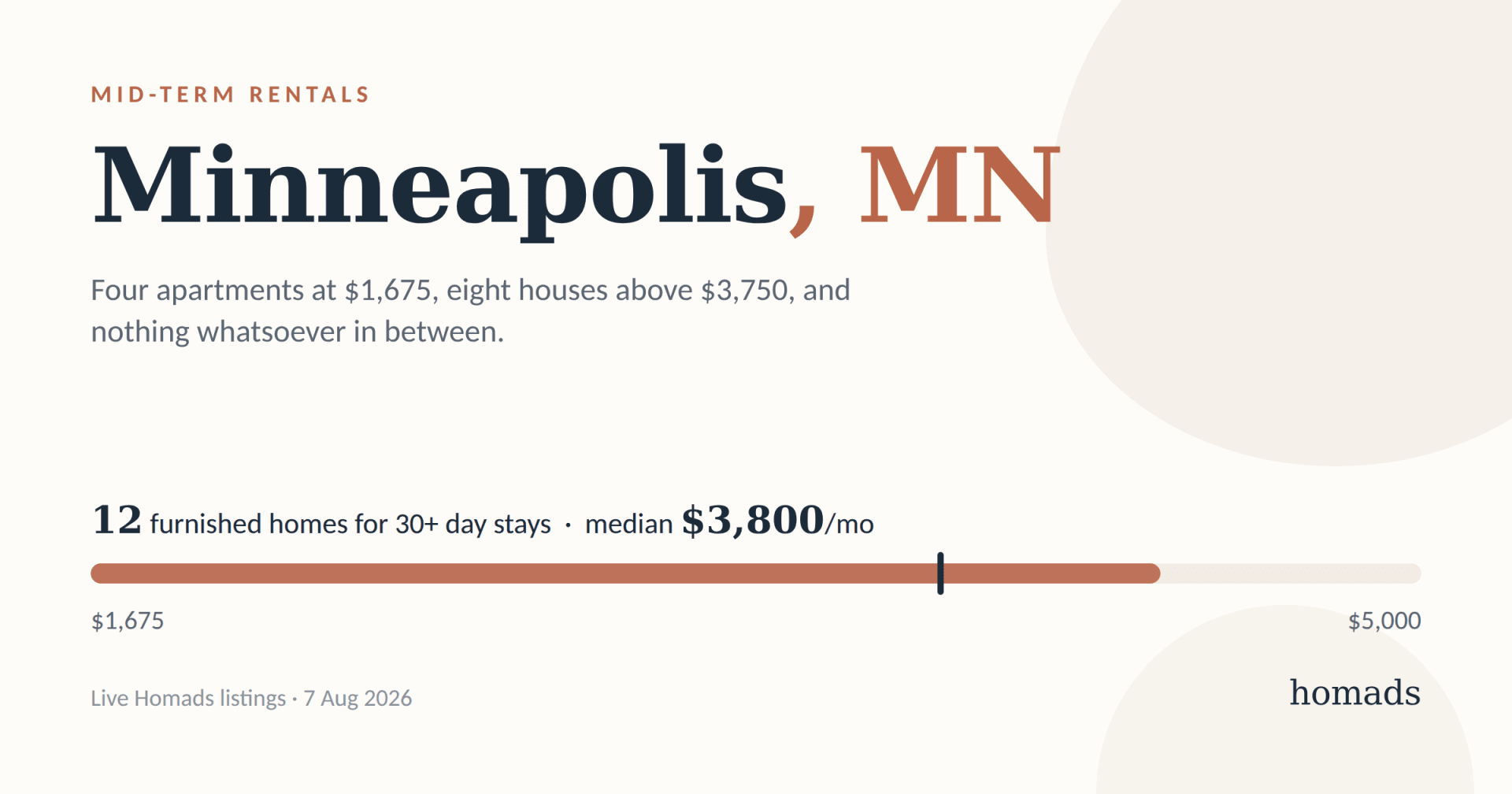
On 7 August 2026 there were 12 places listed on Homads for 30+ day stays with a Minneapolis address, from seven owners. All twelve are entire homes; there are no private rooms.
Prices run from $1,675 to $5,000 a month, with the middle at $3,800.
That median is misleading and you should ignore it, because the market is really two clumps with nothing in between:
Four apartments at exactly $1,675, all one-bedrooms, all at the same West 22nd Street address in Stevens Square. Titles include For Nomadic Travelers and Unit near Downtown Minneapolis.
Eight houses and duplexes from $3,750 to $5,000.
There is nothing at all between $1,675 and $3,750. You are choosing between a one-bedroom apartment near downtown at a genuinely low price, or a whole house at more than double it. There is no middle.
Against the conventional market, RentCafe put the Minneapolis apartment average at $1,709 as of 1 August 2026, up 2.74% year over year — a studio at $1,220, a one-bedroom at $1,526, a two-bedroom at $2,099. Which makes those four $1,675 apartments remarkable: furnished, by the month, for about ten percent above what an unfurnished one-bedroom costs on a year's lease. That is the narrowest furnished premium anywhere in this series. If they suit you, take one.
On bedrooms: four one-bedrooms (the Stevens Square four), one two-bedroom, six three-bedrooms and one four-bedroom. The house end of this market is family-shaped.
Numbers move. Everything above came off the live listings on 7 August 2026 — worth checking the current set before you plan around it.
Where to stay — and the address warning that matters most
Here is the thing to understand before you look at a single listing: half of these are not in Minneapolis.
All twelve carry a "Minneapolis, MN" mailing address. Six are inside the city. Six are in three separate suburbs.
Actually in Minneapolis — six.
Stevens Square. ZIP 55404 — the four $1,675 one-bedrooms at one West 22nd Street address. Just south of downtown, dense and central, walkable to the Convention Center and a short hop from the medical campuses at Hennepin Healthcare and Abbott Northwestern. This is the best-located and cheapest inventory in the set, and it is the same building four times.
Tangletown. 55419 — two houses on Oliver Avenue South at $3,800 and $4,200, next door to each other at 5515 and 5517. South Minneapolis, leafy and residential.
Not in Minneapolis — six.
Two houses in 55423 at $3,750 and $3,800 are in Richfield, a separate city immediately south of Minneapolis. One at 55426, $4,800, is in St. Louis Park. One at 55416, $3,800, on France Avenue South sits in a ZIP that spans Minneapolis, St. Louis Park, Golden Valley and Edina — verify that one specifically. And two at 55447, $5,000 each, on 12th Avenue North and 9th Avenue North, are in Plymouth, about fifteen miles north-west.
Why this is not pedantry. Minneapolis's 0.5% city sales tax, its 3% entertainment tax and its 3% lodging tax do not apply outside the city limits — so the tax arithmetic above changes. Neither do Minneapolis's short-term rental ordinance or its rental licensing rules. And practically: Plymouth is a fifteen-mile drive, and if you picked Minneapolis for the walkability and the skyways, a Plymouth address will not give you either.
Ask which municipality the property is actually in. Not which ZIP, and certainly not which mailing city.
Where the work is. Hennepin Healthcare is now the largest employer in downtown Minneapolis at 7,200 people, having overtaken Target. The University of Minnesota and M Health Fairview sit across the river in 55414, and Abbott Northwestern is in the Phillips neighbourhood in 55404 — next door to the Stevens Square apartments.
And one warning that is worth more than all of the above to the right reader: Mayo Clinic is not in Minneapolis. It is in Rochester, about 85 miles south-east — a ninety-minute drive. Rochester has its own, much tighter furnished market driven by Mayo patients and staff. If you are coming for an appointment or a rotation at Mayo, you are looking at the wrong city.
Why 30 days, and why the paperwork
The tax. A short lodging stay in Minneapolis carries 12.025% in a furnished apartment or small property — 6.875% Minnesota sales tax, 0.15% Hennepin County, 0.5% Hennepin County Transit, 1.0% metro area, 0.5% Minneapolis city, plus the city's 3% entertainment tax, which applies to short-term lodging citywide with no room threshold. A hotel with more than fifty rooms adds a further 3% lodging tax, for 15.025%. (There is no separate downtown surcharge on a room rate — the downtown restaurant and liquor taxes are on food and drink.)
The exemption, and it is exacting. Section 297A.61 subd. 3(g)(2) exempts renting "for a continuous period of 30 days or more under an enforceable written agreement that may not be terminated without prior notice." The Department of Revenue requires the agreement to exist on or before day one, and to contain a termination clause requiring at least thirty days' notice, a date, and both parties' signatures.
Miss any of that and you are taxed on the whole stay, however long you end up staying. This is the one city in this series where the paperwork is more important than the calendar.
Now the second job that same document does. Minnesota has no hotel or lodging exclusion in its landlord-tenant statute and no day count. Minn. Stat. § 504B.001 defines a residential tenant simply as "a person who is occupying a dwelling in a residential building under a lease or contract, whether oral or written, that requires the payment of money." A furnished apartment occupied under a written lease is a dwelling in a residential building — so you are a residential tenant from day one, with the full protections of Chapter 504B, including the requirement that a landlord use the court eviction process rather than a lockout.
One agreement, two results. Sign it before you move in and you are simultaneously tax-exempt and legally protected. It is the cleanest arrangement of any city we have looked at, and it costs nothing but asking.
Your host's licence. Minneapolis's short-term rental regime — registration for owner-occupied units, a rental dwelling licence with condition-based Tier 1/2/3 fees for the rest, one non-homestead short-term rental per owner, and a 10% cap on units in buildings of twenty or more — governs stays of less than 30 consecutive days. At 30+ your host instead needs a standard Rental Dwelling Licence under § 244.1810(a), and operating without one is a misdemeanour. It is reasonable to ask for the licence number.
Nothing here is legal or tax advice, and rates and rules change. Check the current position before relying on it.
Does the time of year matter?
Winter is the defining variable and there is no point being coy about it.
January averages a low of 8°F and a high of 24°F, and the city gets about 51 inches of snow a year — 11.4 inches in December, 11.0 in January, 9.5 in February, and still 8.2 in March. That is a five-month season.
The skyways are the single biggest quality-of-life decision you will make. The Minneapolis Skyway System runs 9.5 miles across 80 downtown blocks, fully enclosed and heated. But it has no uniform opening hours — each segment belongs to the building it passes through, and many close evenings and weekends. It is a weekday-daytime asset, not a 24-hour network. If you are here between December and March and working downtown, a skyway-connected building is worth paying a real premium for. If you are in Tangletown or Richfield, budget for winter driving and for clearing a car.
January and February are the softest months for pricing and the easiest to negotiate — the direct trade-off for the weather.
Late June and early July brings the medical residency and fellowship intake, concentrated near the university and the hospital campuses.
August and September is the worst arrival window — University of Minnesota move-in colliding with general lease turnover. Book six to eight weeks ahead.
Who's actually renting here
Healthcare, and it is unusually concentrated downtown. Hennepin Healthcare's 7,200 employees make it the largest downtown employer, and between the University of Minnesota's academic medical enterprise, M Health Fairview and Abbott Northwestern, the city runs a continuous cycle of thirteen-week travel contracts, locum placements and rotating residents. The Stevens Square apartments are well placed for most of it.
Corporate downtown, which is smaller than it was. Target now employs about 7,100 in the city core, down more than 40% in a decade from roughly 12,500. Downtown office vacancy is about 20% overall and 24% in the central business district. That is bad for landlords and good for you — it correlates with soft downtown residential pricing and real availability.
But the direction has turned slightly. Total downtown employment is around 217,000, and the top fifteen employers added roughly 1,500 workers year over year, helped by return-to-office mandates at U.S. Bancorp and Target. Relocations and project stays are picking up.
Visiting academics and graduate students. The University of Minnesota brings postdocs, visiting scholars and term appointments, concentrated across the river in 55414 — where, note, none of these twelve listings is.
People landing before a winter. Minneapolis is a city a lot of people are unsure about until they have done a January in it. Three furnished months is a considerably cheaper way to find out than a year's lease.
None of them knows their exit date precisely. That is the whole reason this category exists.
Where to start
Look at what is currently listed in Minneapolis, and ask two questions before anything else. Which municipality is it actually in — half of these are Richfield, St. Louis Park or Plymouth with a Minneapolis mailing address. And will the host sign a written agreement with a thirty-day notice clause on day one — because in Minnesota that single document removes 12% and makes you a protected tenant at the same time. If the category is new to you, what mid-term rentals are is the shorter explanation.
Listing counts and prices were read from live Homads data on 7 August 2026 and will have changed. Tax rates, the written-agreement requirement and the tenancy definition were checked the same day against the Minnesota Statutes, the Minnesota Department of Revenue and the Minneapolis Code of Ordinances.