
In Denver you can look up your landlord before you book.
Since 1 January 2024 every residential property in the city rented for 30 days or more has needed a Residential Rental License, and getting one means passing an inspection by a certified third-party inspector — smoke alarms, carbon monoxide detectors, GFCI outlets, the basics. The licence is a public record. You can type an address into the city's licence search and see whether the place you are about to pay $3,000 a month for is licensed.
Most cities give a mid-term renter nothing like that. It is worth two minutes.
What a month actually costs
On 7 August 2026 there were 11 places listed on Homads for 30+ day stays inside Denver.
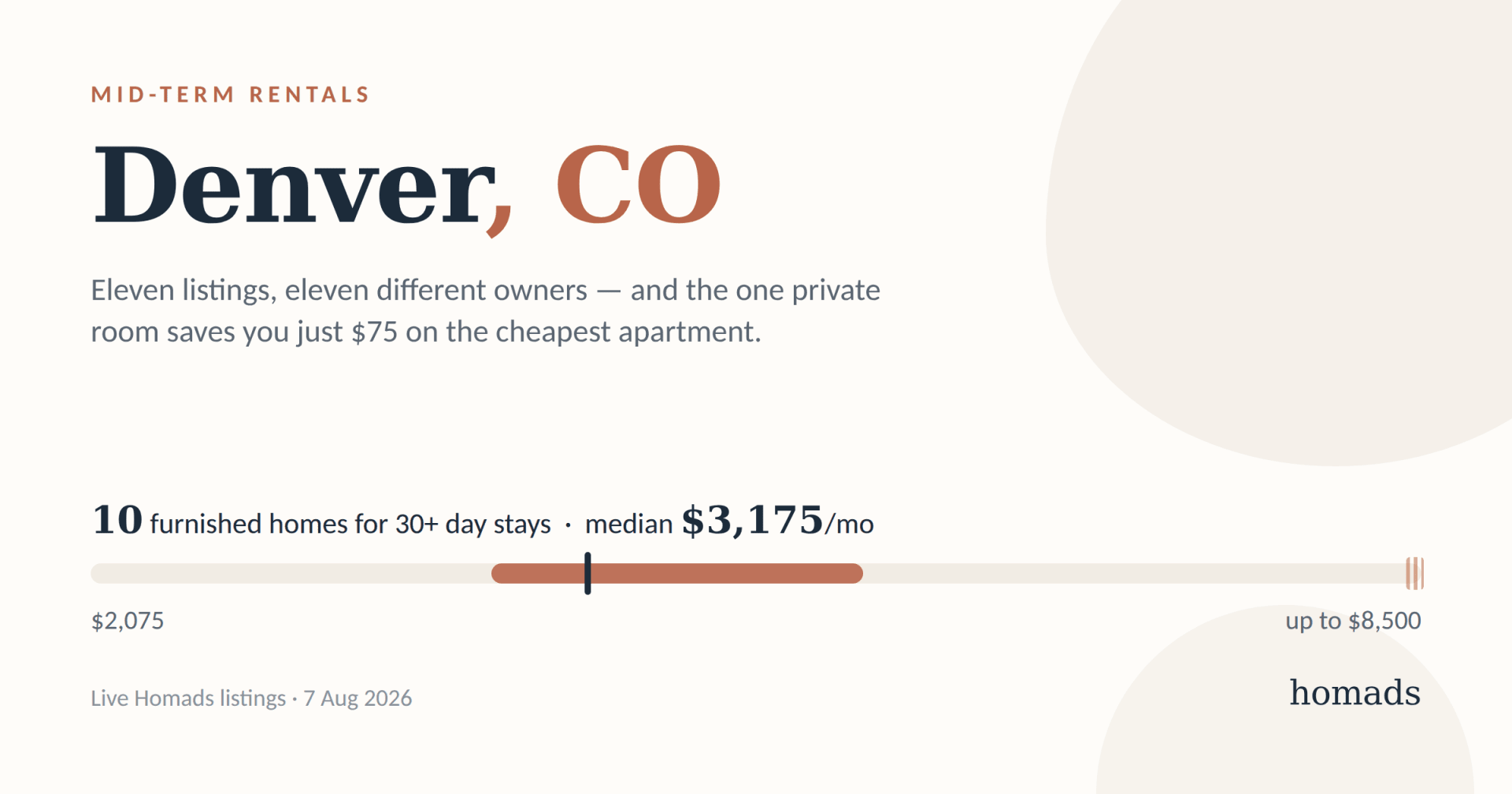
Ten are entire homes, from $2,075 to $8,500 a month, with the middle at $3,175. Half sit between roughly $2,963 and $3,788, which is a narrow band — the middle number here is more reliable than in most cities.
One is a private room, at $2,000.
Read those two numbers next to each other, because they are the most useful thing on this page. The single room in Denver costs $2,000. The cheapest entire apartment costs $2,075. A room here saves you seventy-five dollars. In most cities a private room is the budget option by a wide margin — in Albuquerque a room runs $700 against a $1,500 floor for a whole place. In Denver that discount does not exist. Unless you specifically want to live with someone, take the apartment.
Against the conventional market, RentCafe put the Denver apartment average at $1,910 as of 1 August 2026, down about 2% year over year, with the average one-bedroom at $1,717. Furnished monthly homes ask roughly 1.7 times that. The gap covers furniture, a stocked kitchen, wifi, usually utilities, no twelve-month commitment, and the empty weeks the host carries between stays.
Three things about this set are worth knowing before you start looking.
Every one of the eleven has a different owner. Eleven listings, eleven hosts, no one running two. Whatever else that means, it means you will be dealing with an individual about their own property rather than a leasing desk, and it means the "market" here is genuinely eleven separate decisions rather than one operator's building.
Seven of the eleven are one-bedrooms. Two are two-bedrooms, one is a three, one is a five. If you are one person on a contract, Denver's stock is shaped for you. If you are moving a family, it is not — there is exactly one place here with three bedrooms or more under $8,000.
The eleven sit in ten different ZIP codes. There is no cluster. Only 80218 has two. That is unusual and it changes how you search: in Houston or Albuquerque you can pick a neighbourhood and find several options, and in Denver you more or less have to pick a listing and then decide whether you can live where it is.
Numbers move. Everything above came off the live listings on 7 August 2026 — worth checking the current set before you plan around it. That page pulls a radius rather than the city limits, so it shows more.
Where to stay, depending on why you're here
With ten ZIPs and eleven listings, the honest framing is not "which neighbourhood" but "which of these is near the thing you came for."
Denver Health and the west side. ZIP 80204, which covers Sun Valley and the blocks around 777 Bannock Street — Denver Health's main campus, the city's safety-net hospital system, which serves close to a quarter of Denver's population in a year. One listing.
Capitol Hill and Cheesman Park. 80218, the only ZIP with two. One host names it directly, Capitol Hill Beachy Getaway; the other is a condo on Clarkson Street the host describes as close to downtown and the hospitals, at $2,075 — the cheapest entire place in the city. This is the dense, walkable, pre-war part of Denver, and it is also the cheapest of the eleven. That combination does not usually hold.
Congress Park and Cherry Creek North. 80206, which is also where National Jewish Health sits, at 1400 Jackson Street. That matters more than its size suggests — National Jewish has ranked first or second in the country for pulmonology in essentially every year since 1997, and patients fly in from other states and other countries for evaluations. The one listing here is a furnished studio at $3,997.
Five Points and Whittier. 80205. The single private room, at $2,000.
RiNo and the north. 80216, covering Elyria-Swansea and the northern edge of the River North art district. One listing, a one-bedroom at $3,200 whose host calls it Luxe RiNo. This is also where the National Western Center is — see the seasonality note below, because it matters in January.
University and Platt Park. 80210, south of downtown near the University of Denver. One listing, a three-bedroom basement unit at $2,950.
Virginia Village and the south-east. 80222 and 80246, one each.
Montbello. 80239, far north-east, out toward the airport corridor.
Two address warnings, because Denver's ZIP boundaries do not match its reputations.
The first: one listing is titled simply Cherry Creek, and it is in 80246 — which the Postal Service files under Denver but which is really Washington Virginia Vale, with Glendale as an accepted city name. Cherry Creek North, the shopping district people mean when they say Cherry Creek, is 80206. These are near each other. They are not the same place, and one of them is a separate municipality.
The second, and larger: the $8,500 five-bedroom is in 80221, which has a Denver mailing address but sits in Adams County — the same ZIP also accepts Federal Heights, Thornton and Westminster. If you need to be in Denver proper, that one is not.
And the biggest placement note of all. The largest medical employer in the region is not in Denver. CU Anschutz Medical Campus is in Aurora, roughly eight miles east of downtown, and it holds UCHealth University of Colorado Hospital, Children's Hospital Colorado and the Rocky Mountain Regional VA Medical Center on one site with close to 25,000 faculty and staff. None of the eleven listings above is in Aurora. If your badge is for Anschutz, search Aurora directly — do not assume a Denver address puts you close.
Why 30 days is the line that matters
Denver draws the line at 30 days twice, in opposite directions, and it is the only city we have covered where crossing it moves you from one licensing regime into another rather than out of regulation altogether.
Below 30 days. Denver defines a short-term rental as a dwelling rented for fewer than 30 consecutive days, and a short-term rental licence is only available for the host's primary residence — the place where their habitation is fixed and which is their usual place of return. Investment properties and second homes cannot legally be short-term rented in Denver at all. This is one of the strictest rules in any large American city.
At 30 days and above. You leave that regime entirely. No primary-residence restriction, which is why a furnished monthly market can exist here at all. But the property now needs the Residential Rental License described at the top of this piece, with the inspection behind it.
The tax. A short stay in Denver carries 14.75% — 10.75% city lodger's tax, 2.9% Colorado state sales tax, 1% for the Regional Transportation District and 0.1% for the Scientific and Cultural Facilities District. At 30 consecutive days it goes to zero. On a $3,175 month that is about $468.
And the exemption is available from the first night, not the thirty-first. Colorado's rule requires that the person be a permanent resident of the accommodation and that they "enter into or have entered into a written agreement for occupancy of such room or accommodations for a period of at least thirty consecutive days." The phrase "or has entered into" is the important part: a signed thirty-day agreement in place before you arrive is the qualifying document. You are not paying tax for a month and claiming it back.
So the practical instruction is short: get the length in writing before check-in, and do not let a stay be booked as a rolling 29 days.
One thing Colorado does not give you. There is no statutory day count at which a guest becomes a tenant. Colorado's landlord-tenant statutes define a dwelling unit as a structure "used as a home, residence, or sleeping place by a tenant" and treat hotel rooms separately, but they set no calendar threshold. The 30-day line above is a licensing line and a tax line. What actually governs your stay is the agreement you sign.
Nothing here is legal or tax advice, and rates and ordinances change. Check the current position before relying on it.
Does the time of year matter?
Two answers, and one of them is specific to a single ZIP.
January, if you are looking in 80216. The National Western Stock Show runs sixteen days each January at the National Western Center, and the 2026 edition drew 750,039 people — an all-time record. The 2027 dates are 9 to 24 January. That is directly on top of the Elyria-Swansea and north-RiNo listings. If your stay overlaps, lock a monthly rate early.
Winter generally. Denver averages about 60 inches of snow a year, with the first measurable fall typically arriving around 18 October and the last around 27 April. That is a long season, and it is also the reason a meaningful number of people rent here for three months: Denver is the cheapest practical base for the I-70 ski corridor, and a furnished winter is a real category.
Otherwise the climate is easy to live in. July averages a 90°F high, January about 47°F, and the city gets roughly 245 sunny days a year. That is well above the national average of about 205 — and it is not the "300 days of sunshine" the brochures claim, which is a myth worth retiring.
On altitude, an honest correction. Denver sits at 5,280 feet and people worry about this more than they need to. A high-altitude physician at CU Anschutz puts it plainly: altitude sickness "is rare in locations lower than 8,200 feet." Denver is well under that. What the elevation does do is help you: spending a night at Denver's altitude has been shown to significantly reduce the odds of getting sick when you go higher. If the mountains are part of why you are here, a month in Denver first is not just cheaper than a mountain town — it is better preparation.
Who's actually renting here
Traveling clinicians and medical trainees. The standard travel contract is thirteen weeks. The regional teaching hospitals are concentrated at CU Anschutz in Aurora, but Denver Health, National Jewish Health and the downtown hospital campuses all run rotations of their own, and the trainees rotate through more than one site.
Patients, and the people who come with them. This is unusual enough to name separately. National Jewish Health draws respiratory and immune patients nationally and internationally for evaluations that are not day trips, and a small lodging industry has grown up around it. If you are the one travelling for care, a furnished month near 80206 is a real alternative to a hotel.
Federal and contractor staff. The Denver Federal Center in Lakewood holds about 6,200 federal employees across 28 agencies on 670 acres — the largest concentration of federal agencies outside Washington, D.C. Agency work brings temporary details and contractor assignments measured in months.
Corporate arrivals, though the picture is mixed. In July 2026 the city launched a $100 million, three-year strategy aimed at creating 10,000 jobs, with $40 million of it specifically for recruiting businesses and workers downtown. The Denver Metro Chamber says it is working with 52 companies weighing the region. That is the optimistic read. The honest one is that the strategy exists because job growth has slowed and Colorado dropped from 11th to 25th in CNBC's state business rankings. Denver is competing for arrivals right now rather than absorbing them automatically.
People trying the city on. Denver's neighbourhoods are not obvious from a map, and — as the two address warnings above show — a Denver mailing address does not reliably mean Denver.
None of them knows their exit date precisely. That is the whole reason this category exists.
Where to start
Look at what is currently listed in Denver. Check the ZIP against where you actually need to be before anything else, because the eleven places here are scattered across ten of them and one is in another county. Then run the address through the city's licence search. If the category is new to you, what mid-term rentals are is the shorter explanation.
Listing counts and prices were read from live Homads data on 7 August 2026 and will have changed. Tax rates, the licensing rules and the exemption wording were checked the same day against the City and County of Denver, the Colorado Department of Revenue and the Colorado Revised Statutes.