
Dallas has spent three years in court over short-term rentals.
The city passed two ordinances in June 2023 to push them out of single-family neighborhoods. A Dallas County judge blocked both that December. The Fifth Court of Appeals upheld that block in February 2025, withdrew its opinion, and upheld it again in July. The city took the case to the Texas Supreme Court in October 2025, and as of this summer it is still pending and the ordinances are still on hold.
None of it applies to a stay of a month.
Dallas defines a short-term rental as a rental of "fewer than 30 consecutive days or one month, whichever is less." Thirty days puts you outside the ordinance, outside the litigation, and outside a 15% hotel tax. On a $3,000 month that last part is about $450, and unlike most cities you do not have to wait 30 days to get it.
What a month actually costs
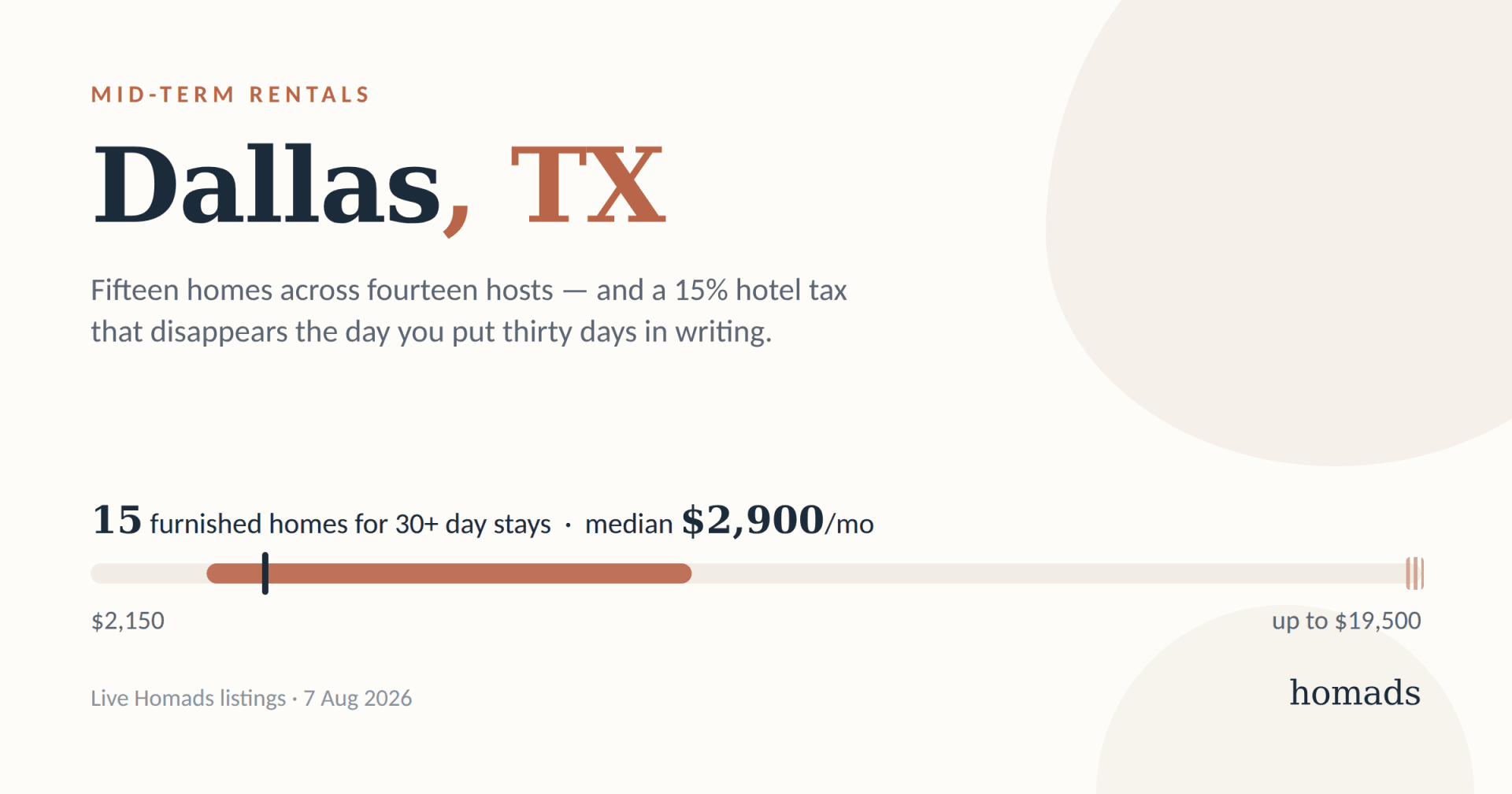
On 7 August 2026 there were 15 homes listed on Homads for 30+ day stays inside Dallas. Asking prices ran from $2,150 to $19,500, with the middle at $2,900.
That range is misleading, so here is the honest version: 12 of the 15 sit between $2,150 and $5,500. The other three — a $9,500 townhome in 75219 and two four-bedroom houses at $16,500 and $19,500 in the affluent northwest — are a different product aimed at a different renter. If you are looking for somewhere to live for three months, the working range is the first number.
Against the conventional market, RentCafe put the Dallas apartment average at $1,592 as of 1 August 2026, down about 1% year over year. Furnished monthly homes ask roughly twice that — the place comes with furniture, a stocked kitchen, wifi and usually utilities, and the host carries the empty weeks between stays.
Two things about this set are worth knowing before you start looking.
Dallas is not the house market its Texas neighbors are. Houston and San Antonio inventory is dominated by three- and four-bedroom houses. Dallas is four condos, four houses, three apartments, two duplexes, a townhome and a guest house — and nine of the fifteen are one- or two-bedrooms. If you are one person on a contract who wants a small place near work, this is the easiest of the Texas cities to do that in.
There is nothing under $2,000, and nothing shared. The floor is $2,150. Every one of the fifteen is an entire home — no private rooms, no roommate arrangements. That is unusual, and it means the cheapest way to be here for a month is still a whole apartment.
Numbers move. Everything above came off the live listings on 7 August 2026 — worth checking the current set before you plan around it. That page pulls a radius rather than the city limits, so it shows around 44 homes across the metro, including Arlington, Lewisville and the mid-cities.
Where to stay, depending on why you're here
Dallas is a driving city and the highways decide everything. The useful way to narrow it down is by what you need to be near.
UT Southwestern, Parkland and the Medical District. ZIP 75235 is the medical core and holds three of the fifteen listings. Two hosts have already named it in their listing titles — Spacious Apartment in Dallas Medical District and, from across the river in 75211, Golf Course Condo Near Downtown/UTSW/Methodist. When hosts start labeling by hospital, it tells you who has been booking.
Uptown, Oak Lawn and the Design District. ZIP 75219, also three listings, and the widest price spread in the city — a two-bedroom apartment at $2,999 and a townhome at $9,500 sit in the same ZIP. This is the walkable part of Dallas and it is priced accordingly.
Bishop Arts and North Oak Cliff. 75208, just southwest of downtown, and 75211 beyond it. The cheapest entire places in the city are here, from $2,150.
The downtown edge. One host lists a Downtown Dallas Condo in 75215, just south of the core and near the convention center, which is midway through a rebuild running to 2030.
East Dallas. 75214, where one host describes their listing as an entire apartment at historic Munger Place. Older housing stock and tree cover, and closer to the Baylor campus than the drive time suggests.
Northeast, toward Richardson. 75243, the only three-bedroom in the city set under $3,500. Sensible if your work is up US-75 rather than downtown.
A note on the map. These fifteen are inside the Dallas city limits, but the metro is polycentric in a way few American cities are — Las Colinas, Plano, Irving and Fort Worth are separate employment centers with their own inventory. If your commute points at one of those, search that city directly rather than assuming Dallas is the right base.
Why 30 days is the line that matters
Two separate rules stop at the same place, and one of them is worth real money.
The ordinance. Dallas Development Code defines a short-term rental as a rental of "fewer than 30 consecutive days or one month, whichever is less." At 30 days you are outside the registration regime entirely, and outside the density and zoning fight that has occupied the city since 2023.
The tax. Dallas charges 15% on short stays — 6% state hotel occupancy tax plus 9% city. Texas exempts anyone who has the right to occupy for 30 consecutive days or more. What makes this better than most cities is the timing: per the Texas Comptroller, if you give the host written notice beforehand that the stay will be 30 days or longer, the exemption applies from the day of notification. You are not paying tax for the first month and getting relief on day 31. You are not paying it at all.
So: put the length in writing before you move in, and do not shorten a 31-day booking to 28 to save a few nights. The tax on those 28 nights will cost more than the nights you saved.
One thing Dallas does not give you. Texas has no statutory day count at which a guest becomes a tenant. Nevada has one, California has one, Texas does not — the 30-day line above is a tax definition and a zoning definition, and it does not by itself create tenancy rights. What governs your stay is the agreement you sign, which is a reason to read it properly rather than assume a month buys you a tenant's protections.
Two contradictions on the city's own website are worth knowing about, because you may run into them. Its financial transparency page still lists the city hotel tax at 7% — the rate went to 9% in January 2023 — and describes a short-term rental as "30 days or less," which is not what the ordinance says. The ordinance and the Comptroller are the ones that count.
Nothing here is legal or tax advice, and the litigation was live as this was written. Check the current position before relying on it.
Does the time of year matter?
Summer is the real variable. Dallas–Fort Worth averages sixteen or seventeen days at or above 100°F in a normal year, usually starting in late June. In 2026 the first did not arrive until 7 July, which was unusually late and does not mean much for next year. If you are here between June and September, ask what cooling a place actually costs before agreeing to pay utilities.
The other rhythm is corporate. Relocations cluster around the start of quarters and the end of the school year, which is when the furnished stock moves fastest.
Who's actually renting here
Traveling healthcare workers. The standard contract is thirteen weeks. UT Southwestern alone employs more than 25,000 people and carries about 1,400 residents and 574 postdocs on fixed-length rotations, and Parkland is adding 112 beds across 2026. That is a steady flow of people who need somewhere for three months near a specific campus.
Corporate relocations, and there are a lot of them right now. Goldman Sachs is moving into an 800,000 square foot campus north of downtown built for more than 5,000 employees, with people arriving in waves through 2028. Wells Fargo opened a $570 million, 4,500-person campus in Las Colinas in October 2025. Neither of those is a single moving day.
Project and construction crews. The convention center rebuild runs to 2030, and both of those campuses are still filling.
People landing before they commit. Dallas is large, and which part of it you should live in is genuinely hard to guess from outside. A furnished month is a cheaper way to find out than a twelve-month lease in the wrong ZIP.
None of them knows their exit date precisely. That is the whole reason this category exists.
Where to start
Look at what is currently listed in Dallas, and check whether your commute actually points at Dallas proper or at one of the metro's other centers before you narrow down. If the category is new to you, what mid-term rentals are is the shorter explanation.
Listing counts and prices were read from live Homads data on 7 August 2026 and will have changed. Tax rates, the ordinance definition and the status of the city's appeal were checked the same day against the Dallas Development Code, the Texas Comptroller and the Texas Tax Code.