
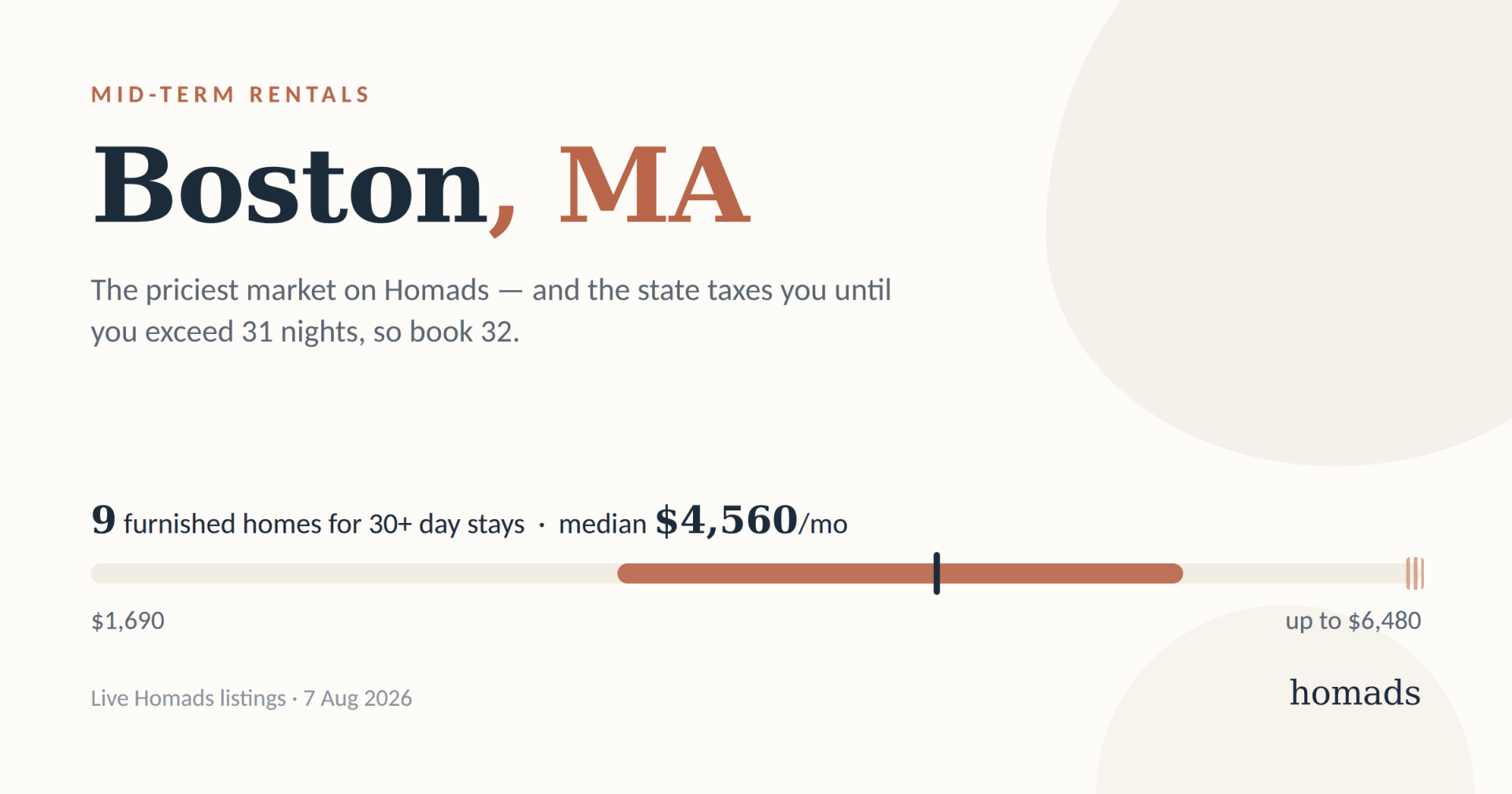
Book thirty-two nights in Boston. Not thirty. Not thirty-one.
Massachusetts taxes a furnished apartment let as a "short-term rental," and the statute defines that as occupancy "for a period of not more than 31 consecutive calendar days" — M.G.L. c.64G § 1. Read it carefully: a thirty-one-night stay is still inside the definition. You have to exceed thirty-one.
Get to thirty-two and the regulation is unusually generous: where occupancy exceeds 31 consecutive days, "no excise is imposed on any portion of the stay" (830 CMR 64G.1.1(3)(b)1). Not a refund at the end — nothing charged at the start.
Boston's rate is 14.95%. On the $4,560 median that is about $682 a month. One extra night is the cheapest money you will ever save.
What a month actually costs
On 7 August 2026 there were 12 places listed on Homads for 30+ day stays inside Boston, from four owners. Boston is expensive and the numbers below say so plainly.
Nine are entire homes, from $1,690 to $6,480 a month, with the middle at $4,560. Half sit between roughly $3,480 and $5,400.
Three are private rooms, at $1,650, $1,750 and $2,090 — all three in Dorchester.
That $4,560 median is the highest of any city in this series. It is also, in fairness, not far off what Boston costs unfurnished: RentCafe put the city's apartment average at $3,716 as of 1 August 2026, down 2.3% year over year, with a two-bedroom at $4,323 and a three-bedroom at $4,955. The furnished premium here is narrower than in most cities, because the underlying rent is already so high.
Two things you should know before you look.
Most of this is one operator, and they are good at it. Seven of the twelve carry the same naming convention — The Roseclair, The Dorset, The Grand View, The Sumner Redline, The Penthouse, The Annabel 2 — across four Dorchester addresses, plus The Strathmore 15 and The Strathmore 9 at one Brighton address. What that operator does that is genuinely useful: at 230 Boston Street they list a single bedroom at $1,650 and the whole three-bedroom apartment at $5,400. Same building, both options, priced consistently. If your budget is $1,700 rather than $5,000, Boston still has something for you — it is just a room rather than a flat.
Almost everything is an apartment. Eleven of the twelve. One house. Six are one-bedrooms or single rooms, four are two-bedrooms, two are three-bedrooms.
Numbers move. Everything above came off the live listings on 7 August 2026 — worth checking the current set before you plan around it. That page pulls a radius rather than the city limits, so it shows more, including Cambridge and Somerville.
Where to stay, depending on why you're here
Dorchester. ZIP 02125 — seven of the twelve, and the whole affordable end of the city. Four addresses: 230 Boston Street (a bedroom at $1,650, a bedroom-in-a-3BR at $1,690, a two-bedroom penthouse at $4,560 and the whole three-bedroom at $5,400), 14 Peverell Street (a master bedroom in a five-bedroom, $1,750), 47 Sumner Street (a private suite, $2,090) and 26 Annabel Street (a three-bedroom at $5,510). Savin Hill, Columbia Point and the UMass Boston side of the neighbourhood, on the Red Line.
Brighton. 02135 — two apartments at one Strathmore Road address, a one-bedroom at $3,440 and a two-bedroom at $3,480. Western Boston, near the B and C branches of the Green Line, and traditionally where the student overflow lives.
Jamaica Plain. 02130. One two-bedroom on Sheridan Street at $4,000, which the host describes as near Longwood — and that is the right instinct, because Longwood is the single biggest employment cluster in this city.
Roxbury. 02119. A two-bedroom near Egleston Square at $4,600.
Beacon Hill. 02108. A furnished one-bedroom on Union Street at $6,480 — the most expensive place on this list, and the only one in the historic core.
Where the work actually is, and what is missing from this list. The Longwood Medical and Academic Area — ZIPs 02115 and 02120 — holds roughly 73,000 workers and 24,000 students on one campus, and it is the archetypal destination for a three-month furnished stay. There is nothing on this list inside it. The closest are the Jamaica Plain two-bedroom and the Roxbury one. If you are reporting to Brigham and Women's, Beth Israel, Dana-Farber or Boston Children's, factor the commute rather than assuming.
And one thing to be clear about: Kendall Square is in Cambridge, not Boston. Different city, different rules, across the river. If your work is in the biotech cluster, search Cambridge directly.
Why 32 nights is the line that matters
Boston has two thresholds and they are four days apart, which produces a trap in the middle.
The city's line is 28 days. Boston's short-term rental ordinance, Municipal Code Ch. 9-14, defines a short-term rental as occupancy "for a period of fewer than twenty-eight consecutive calendar days." Everything in that regime — the registration, the requirement that the operator be a natural person occupying the building, the Limited Share / Home Share / Owner-Adjacent categories, the effective ban on investor-owned units — stops there. At 28 nights or more your host is not running a short-term rental at all, which is precisely why whole furnished apartments exist here.
The state's line is 31 days, and you must clear it. M.G.L. c.64G § 1 taxes short-term rental occupancy of "not more than 31 consecutive calendar days." So a 29-night stay is outside Boston's ordinance and fully taxable at 14.95%. That gap — 28 to 31 nights — is where people get caught, usually by a listing advertising a "30-day minimum."
So: thirty-two nights, in a written lease, before you arrive. It clears both.
A second, cleaner route. M.G.L. c.64G § 2 exempts "tenancies at will or month-to-month leases" entirely, regardless of length. If your host offers a genuine month-to-month tenancy rather than a fixed booking, the excise does not apply at all — but understand that it makes you a tenant under M.G.L. c.186 with a notice period on both sides, which is a trade some hosts will not want and some renters will.
One thing to avoid. If a property rents rooms individually to four or more unrelated people, it may be a "lodging house" under c.64G § 1 — and lodging houses run on the 90-day threshold instead, meaning a 45-night stay would be taxable. Three of the listings above are single rooms in shared houses. Ask how many rooms are let separately before you assume the 32-night rule applies.
And what Massachusetts does not give you. There is no statutory day count at which a guest becomes a tenant. Status turns on whether you signed something that created a tenancy, not on nights elapsed — which cuts in your favour, because a written furnished lease makes you a tenant on day one. Massachusetts also has no rent control (banned statewide in 1994) and Boston has no just-cause eviction requirement — the Jim Brooks Act went to study in 2018 and never became law. Your lease term is your protection. Get the full term in writing.
Nothing here is legal or tax advice, and rates and rules change. Check the current position before relying on it.
Does the time of year matter?
More than in any other city in this series, and it comes down to one date.
1 September. Roughly two-thirds to seventy percent of all Boston leases end on the same day — a convention dating to 1899. The conventional rental market clears in a single twenty-four-hour period, units for September are typically shown and signed between February and May, and the streets of Allston, Brighton, Fenway and the South End fill with abandoned furniture. The 2023 edition produced 38 tons of waste and 1,700 discarded mattresses.
What that means for you is the whole reason this category exists in Boston. If you arrive in January, or March, or June, the twelve-month market has nothing for you — it already cleared last September. A furnished month is not a compromise here; for most of the year it is the only product available to someone who did not sign a lease in the spring.
The corollary: late August and early September are the softest weeks for furnished stock, because everything turns over at once. If your timing is flexible, that is when to look.
1 July is the second date. Medical residencies and fellowships start then, and incoming trainees need sixty to ninety days of furnished housing while they search. That is the sharpest annual squeeze on anything near Longwood.
Winter is real. Boston averages 49.2 inches of snow a year — 14.3 inches in January and 14.4 in February. It is a reason to care whether your place is walkable to a T stop, and a reason relocations get deferred out of December through February, which softens pricing.
Who's actually renting here
Hospitals, at a scale that is hard to overstate. Mass General Brigham employs around 82,000 people and is the largest private employer in Massachusetts. Beth Israel Lahey Health has 39,000 and more than 4,700 physicians. Add Boston Children's and Dana-Farber, concentrate a large share of it into the Longwood campus, and you have a continuous flow of travelling nurses on thirteen-week contracts, residents, fellows, locums and visiting researchers.
Students and academics, in volume. 162,458 students were enrolled across 32 Boston institutions in autumn 2024, 39,012 of them living off-campus in private housing. A semester is four months. Visiting faculty come for a term.
Biotech — and here you should be careful. Massachusetts life-sciences employment fell in 2025 for the first time in fourteen years, to 143,224 jobs from 144,669. Greater Boston lab vacancy was 28.7% in the second quarter of 2026, up 250 basis points year over year, with asking rents down for a fourth consecutive quarter. If you are coming for a biotech role, that is not a reason to worry about your own job — but it does explain why the rental market has loosened and why you have more room to negotiate than you would have had two years ago.
People landing before they commit. Boston is small, dense and expensive, and the difference between Dorchester and Brighton and Jamaica Plain is not something you can judge from outside. A furnished quarter is a far cheaper way to find out than signing for a year on 1 September.
None of them knows their exit date precisely. That is the whole reason this category exists.
Where to start
Look at what is currently listed in Boston, and decide first whether a room works for you — because in Boston that is the difference between about $1,700 and about $4,500. Check the commute to Longwood or wherever you are actually reporting, since nothing on this list is inside it. And whatever you book, write it for thirty-two nights. If the category is new to you, what mid-term rentals are is the shorter explanation.
Listing counts and prices were read from live Homads data on 7 August 2026 and will have changed. Tax rates, the occupancy definition and the ordinance thresholds were checked the same day against the Massachusetts General Laws, 830 CMR 64G.1.1 and the Boston Municipal Code.